Aneta Parpouli on Flora & Oizys, a Dance Performance Built From Greek Myth and Depression
Filmmaker and choreographer Aneta Parpouli discusses how an obscure figure from Hesiod's Theogony became the framework for a multimedia dance performance exploring modern mental health.
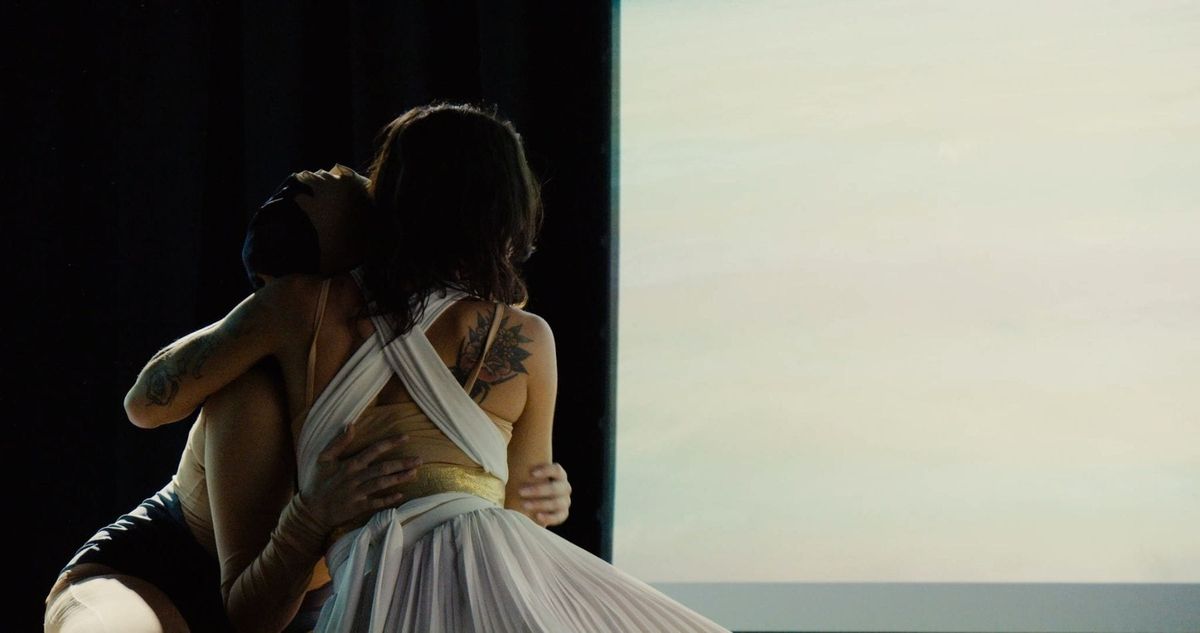
In Hesiod’s Theogony, Oizys is granted a single line before vanishing into the classical ether—a minor deity born to the night, designated as the personification of misery and anxiety. For choreographer and filmmaker Aneta Parpouli, this mythic ellipsis became a framework to examine modern psychological collapse.
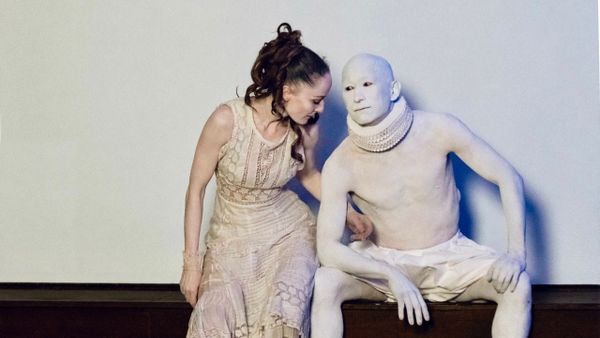
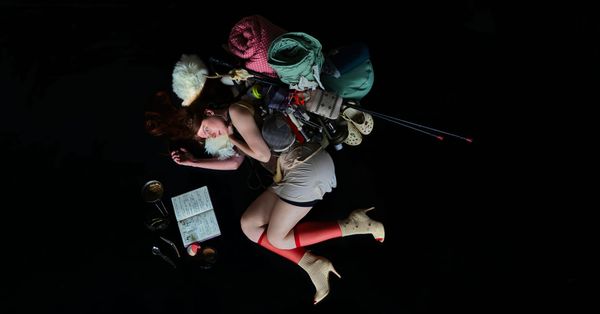
Staged this spring in Salt Lake City, Parpouli’s multimedia performance Flora & Oizys externalizes the internal weight of depression, tracing a woman who gives birth to a physical, genderless personification of her own psychic struggles.
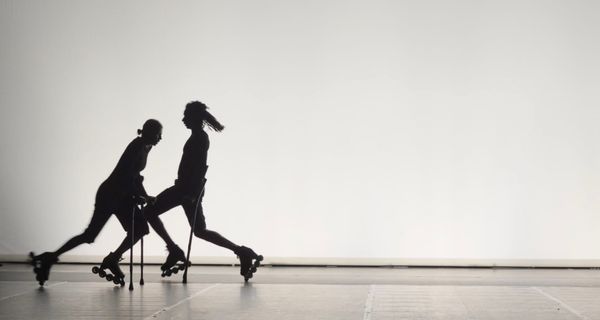
The production functions as a live research laboratory. Spanning three physical spaces, the performance deploys thirteen dancers alongside digital projections and the tactile, unalterable grain of 16mm film. By casting media playback software handlers as active live performers, Parpouli sets up an unpredictable friction between celluloid permanence and the variable, fleeting endurance of the moving body.
What emerges is a project that reclaims ancient archetypes to voice modern trauma, operating at the intersection of cinematic architecture and somatic vulnerability. We spoke with Parpouli about translating clinical symptoms into mythic movement, navigating the trap of choreographic cliché, and the reality of staging a performance where the live body holds the power to overwrite the screen.
Why Oizys specifically? What drew you to this particular figure out of all of Nyx's children, over the more prominent, dramatic figures in the Theogony?
The choice of Oizys, and generally the first generation of Gods in Theogony, rather than the most well-known and prominent figures, ties back to the notion that, in Greek mythology, mental health struggles are not directly named or addressed as they are today. Disorders like depression, anxiety, BPD, bipolar, etc., are present in the ancient texts but hidden behind external forces like vengeful gods, strong, noble men, and hysterical women. Similarly, in my research, Oizys proved to be one of the least mentioned, depicted, and represented deities, yet was clearly described as the goddess of depression and misery. This duality of underrepresentation and direct naming in today's terms of mental health recognition felt like an opportunity to give Oizys a most prominent place in art, while exploring the character's depth and assigning multiple layers to one of Greek mythology's 'boogeymen.'
Also, the female identity assigned to Oizys was, at the time, and still is, an interest of my artistic practice. While researching for two other projects, I noticed that in the Fabulae by Gaius Julius Hyginus, which is a list of the suicides in mythology, men committed suicide for matters of honor and country, out of valor and self-sacrifice, while women did it after their husbands cheated on them, left them, or rejected them. In Euripides' Medea, the protagonist is portrayed as the vengeful, jealous woman who murdered her own children because her husband left her for another woman, with little said about how she was raised or what troubled her. I aim to give voice and depth to femininities and female identities in this work, and in my work generally. I am a woman, and that is what I know, what I can speak to most truly.
The leap from a short film to a multi-space, evening-length performance is substantial. What was the moment that told you the story could no longer be contained by a screen?
If I have to recall the exact moment I thought ‘this needs to be a live performance’, I would say it was when I assisted in another live multimedia work at the University I attended. I was already struggling to contain a big idea with multiple dancers in one short film, but at that moment, I realized I could do more with it. The decision to leap from a short film to a multi-space evening-length performance was also informed by multiple points in my life. During my Bachelor’s in Film, as a dancer, I began exploring the idea of placing the dancing body on the screen. Coming to Utah for my MFA, I focused almost all of my work on screendance. However, I started thinking to myself that I combined my background in dance and my education in film in only one way. And I wanted to expand this marriage to different spaces and different ways to converse. Because my background was not just in dance but specifically in live dance performance. And that aspect was missing from my dance films. The ephemerality and the thrill of a live moving body. And that is how I began exploring the duality of ephemerality and permanence, and the idea of placing the same body on screen and on stage to tell multiple sides of the story simultaneously.
Mythology addresses suffering but leaves the clinical illness unnamed. Which god-to-symptom pairing required the furthest departure from Hesiod's text to land as a modern depiction of depression?
I would say the deity represented furthest from the mythological text, and the hardest to choreograph, was Sleep (Hypnos). This god was usually described as a kind, beloved man who would help people sleep and bring them good dreams. In Flora & Oizys, the character who gave birth to Sleep was the only symptom-character who had to embody two opposing manifestations of the same symptom: hypersomnia and insomnia. The first task was to assign contradicting intentions to the symptom-character, the second was to represent a combination of struggles through the parent-moving body, and the third was to structure a relationship between those two with narrative meaning. This duet took the most time to create and went through many phases.
The character of Sleep that made it into the final work became more of a neutral handler, rather than a benevolent figure. Ever-present around the Parent, Sleep possesses agency over him, determining when to grant him rest and when to deprive him of it, leaving him shaky, tense, and exhausted. At the same time, the parent also seemed to seek sleep and try to hide its effects. Through the constant shift in agency in this relationship, we witness the physical and emotional struggle of a person who has little control over their ability to maintain a healthy sleep routine. In depression, sleep is uncontrollable and unpredictable rather than restorative, so I needed Sleep to be an impartial force that would let him embody the symptom as part of the illness, not as a refuge from it.
Choreographically, how do you direct thirteen dancers to embody an abstract psychic weight while avoiding literal or theatrical cliché?
We spent months on separate duet rehearsals, working on each parent-symptom relationship. Going into these first rehearsals, I wanted to get the dancers' spontaneous interpretation of the character and the relationship first. My personal experience is a strong source of material, but the dancers' external perspectives added nuance. We went into improvisational tasks based on movement prompts and their own impulses, and we recorded everything. Then I watched the recordings alone, chose phrases and moments, and sent them back to the dancers to work on.
Every couple had its own intricacies, but one constant was that the movement would start from the body part where the symptom is most felt. The heaviness of depression manifested in Oizys was felt more in the chest. Pain and exhaustion were assigned to the arms and legs. This distinction offered many options for experimentation.
While dealing with such intense subject matter, you fall into the cliché trap. We did, and we tried them, and got them out of our systems, which helped us devise different movement patterns. All thirteen dancers were strong movers with strong improvisational skills, very different from one another, and I chose to work with them based on what they could do rather than what I would teach them. The cliché patterns were worked through by a collaborative process among me, the dancers, and the choreography assistants, Marianna Leptokaropoulou and Alexia Maikidou Putrino. The choreography became a result of collective exploration among different perspectives, beyond a singular choreographer's view.
The performance tests the boundary between film's permanence and dance's ephemerality. Does the footage stay fixed from night to night, or is the media itself mutable?
The footage, shot by the Director of Photography Ryan Ross, who also composed the music, is entirely fixed, while the dancers adapt around them. That was my fascination with this play between permanence and ephemerality. I wanted to keep the idea of fixed, pre-edited films and take the bodies inside the screen out into a live environment, keeping the nature of both intact. I was interested in the generative outcome of their cohabitation. What I discovered is that the production process is heavily affected, because neither a film nor a choreographic phrase is ready before the other. They meet, go through a trial-and-error duet, go back separately to different studios, and meet again for a new session. In the live shows, film served as a fixed variable that dictated the timing of the live dancers, along with musical cues. Parts of the choreography stayed improvisational, so the dancers had freedom to play with the image each night.
An example is the living room scene. The duet between Flora and Oizys, danced by Nora Price and Meshayla Gardinier respectively, was entirely improvisational, built on an endurance struggle that tested the limits of time. Two films were meant to screen alongside this duet, but on the first night, the live duet reached its climax before we could reach the second film, so we skipped it. This became a different iteration of the work, and it was why each film sat in a different scene on Isadora software (a media playback software used for live performance), with the projection handlers as alert and engaged as the dancers, performing their own parts based on the show's progression.
The performance's films are permanent for me, since I hold them on my hard drive and can access them anytime. For the audience at the moment of the shows, they were ephemeral, present for that one hour, without a public record. What remains is memory, the same as with the choreography. The show was recorded from every angle for archival purposes and edited to present the most compelling version of each moment, so it exists, even if it stays outside public record. The boundary between permanence and ephemerality gets tested throughout the process and continues in the work's life after the live performance ends.