Latex, Breath, and Resistance: Inside Alice Ripoll’s Adorno
Dila Yumurtaci reviews Alice Ripoll's Adorno, finding that beneath a striking mass of balloons lies a brilliant, vulnerable study on how our ordinary choices reconstruct who we are.

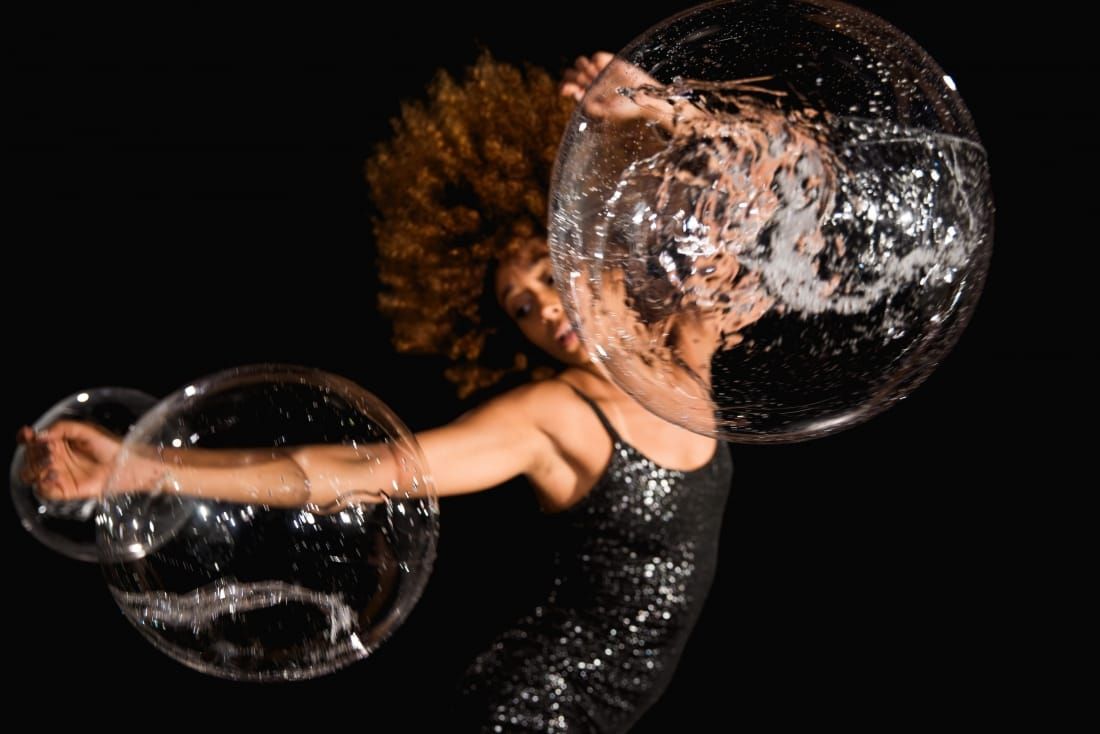
The performance Adorno held its world premiere at the DDD Festival in Porto. I arrived at the theater with no prior expectations, but the moment I stepped into the hall, I was confronted by a striking landscape: thousands of black balloons of varying sizes covered the entire rectangular stage. Seated on either side of this black mass, the audience was immediately immersed in the pungent scent of latex and the uncanny, high-pitched friction of the balloons. I knew then that I was about to witness a work of profound conceptual depth.
As fragments of human limbs began to emerge and shift slowly from beneath the balloons, the stage began to move as if a singular, non-human entity were coming to life. This first section progressed with a heavy, deliberate pace. Bodies would disappear into the mounds of balloons and re-emerge transformed, shifting from human to non-human, serving as a visceral reminder of how we constantly reconstruct our identities. In Portuguese, adorno translates to "ornament" or "adornment." Here, choreographer Alice Ripoll illustrates how we restructure ourselves through these trivial choices and small decorations, showing how the ordinary selections we make can create a monumental impact.
Ripoll, one of the most essential voices in contemporary Brazilian dance, hails from Rio de Janeiro, and the connection between these adornments and the Rio Carnival was evident. Just like Carnival uses costumes and decorations as a collective tool for expression and cultural survival, Ripoll uses these balloons to explore how individual differences manifest within a shared community. What fascinated me most was how these distinct singularities merged into a single entity, surrendering themselves to the fluidity of life.
Ripoll often works with dancers from the North Zone of Rio, specifically the Cia Suave ensemble, merging the kinetic virtuosity of street styles like Passinho and Kuduro with contemporary dance. Their agility was so seamless that they possessed a perfect balance between the precision of a machine and the harmony of an organic entity. We watched them evolve, shifting their initial contact with the balloons into raw contact with one another.
The first part of the performance was void of music; the squeaking of the balloons and the occasional, sharp pop provided a sufficient, tension-filled soundscape. Over time, musical layers were introduced, but it was the dancers’ use of their own breath and voices that carried the most power. As they danced, they collectively created their own soundscape, embodying the beauty of a singular, collective spirit.
The dancers’ theatricality, technical skill, and most importantly their unwavering belief in the work were so potent that their souls seemed visible through their movement. Ripoll’s success lies in her ability to inhabit the "in-between" space: where the conceptual meets the street, and where vulnerability becomes a political strength. Witnessing this ensemble, it was clear that their long-term collaboration has captured a rare energy, one where this collective spirit is elevated into an inevitable, transformative act of resistance and joy.
ABOUT THE WRITER
Dila Yumurtacı is an interdisciplinary artist and researcher working at the intersection of dance, ecology and consciousness. Through participatory performances and workshops, she creates spaces for embodied, more-than-human connection and collective transformation. Based in Porto, she is pursuing a PhD in Arts on eco-somatics, catalyzing collective experiences between Porto and Istanbul.