The Weight of Emptiness: A Review of Harper WANG’s Mo
Tianyi Li reviews Harper Wang's Mo, a dance film where emptiness becomes an active force, and the camera, shadow, and frame choreograph alongside the solitary performer.
by Tianyi LI
Presented at Guangdong Modern Dance Week, Harper Wang's dance film Mo follows a solitary performer through an imagined desert, using choreography, theatrical performance, sound, and cinematic composition to explore isolation, instability, and endurance. The Chinese title 漠 carries several meanings at once: desert, silence, remoteness, emotional distance, and Wang builds all of them into the film's physical and visual structure. Empty space presses against the performer. Shadows stretch the body beyond its own outline. Collapse and recovery repeat until solitude finds its own rhythm.
What sets the film apart is how fully it understands movement as a screen event, not just a filmed event. Camera, framing, light, and editing all shape how the choreography lands. The screen itself becomes a performance space, developing alongside the dancer rather than simply recording her.
The Choreography of Weight and Distance
The movement vocabulary rests on contraction, suspension, interrupted extension, and imbalance. The body reaches outward, then folds back in. It's a simple pattern, and an effective one: every outward gesture seems to carry the resistance of the environment itself.
Weight does most of the dramatic work. The dancer repeatedly lets her centre of gravity drift past a secure base, so that balance feels like it could give out at any moment. Recovery arrives small, a foot adjusts, the torso rotates, momentum shifts suddenly, but each correction is tightly controlled. The body reads as vulnerable and alert, always searching for its next foothold.
Repetition carries memory here rather than just reinforcing a motif. A reaching arm appears first as uncertain, then defensive, then more determined. The body seems to register what it has already survived and adjusts accordingly.
Her background in theatrical performance adds detail to this physical language. In close-up, a shift of focus, a held breath or a slight tightening of the face can change the meaning of a movement. WANG allows emotion to pass through the body gradually. This restraint supports the choreography and gives the performer a clear inner life.
At times, the movement moves close to physical acting. A delayed response to the shadow or a hand left briefly suspended suggests thought before action. These moments are most effective when they remain connected to the rhythm and weight of the body.
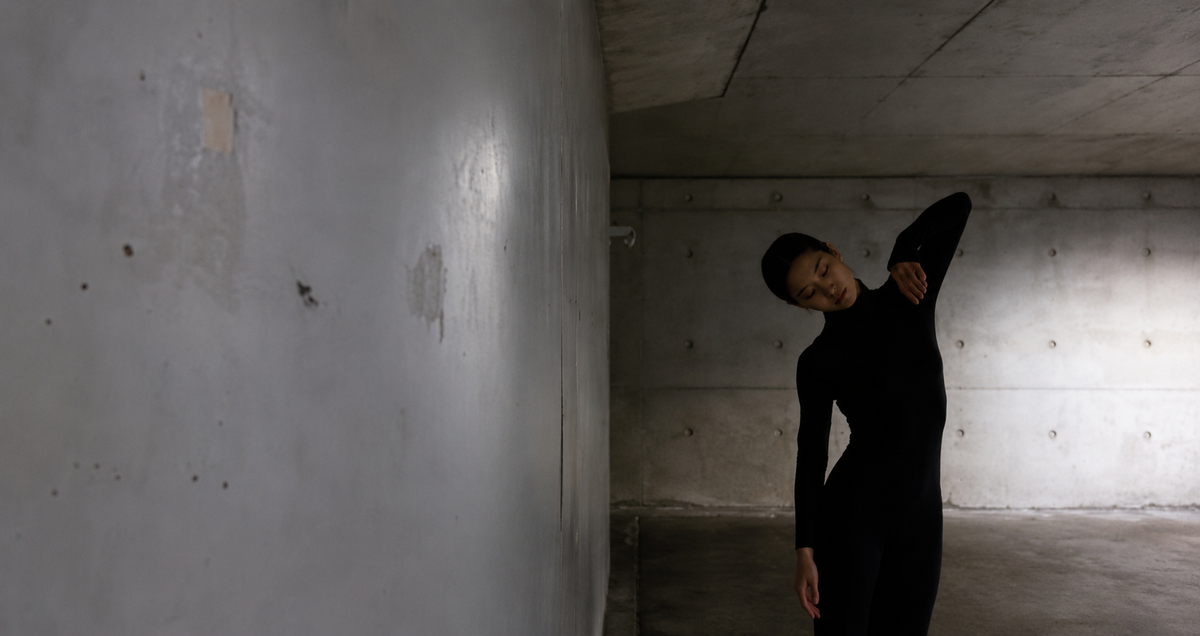
Wang's spatial composition sharpens the effect further. She frequently places the performer off-centre, surrounded by large stretches of empty frame, so that isolation becomes structural rather than symbolic. Crossing that frame starts to look like physical labour.
Where the film loses some momentum is the middle section, which stays in the same emotional and physical register a beat too long. Contraction, restrained pacing, and falling keep the atmosphere intact, but the section would benefit from one sharper break in rhythm or texture, a change in level, speed, or dynamic, to give the later transformation more force when it arrives.
Camera, Shadow, and Screen Choreography
The camera extends the choreography past the dancer's physical reach. Wide shots shrink the performer inside an expansive field; closer framing pulls attention to breath, muscular tension, and shifting focus. The movement between these two scales builds a cinematic rhythm that carries much of the film's visual force.
Editing does comparable work. Cuts interrupt movement, reorient space, and bring separate physical moments into contact with each other: a gesture started in one shot continues, altered, from another angle. The dancer's pathway gets built as much by the edit as by her body.
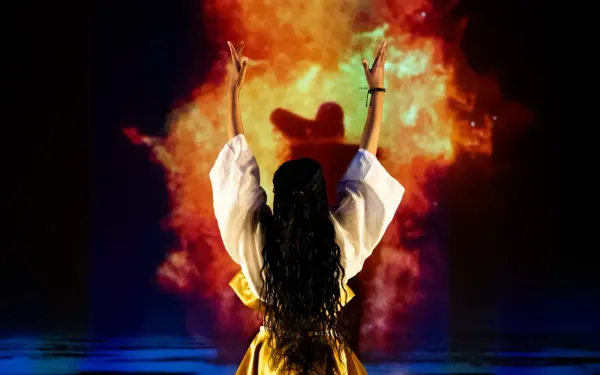
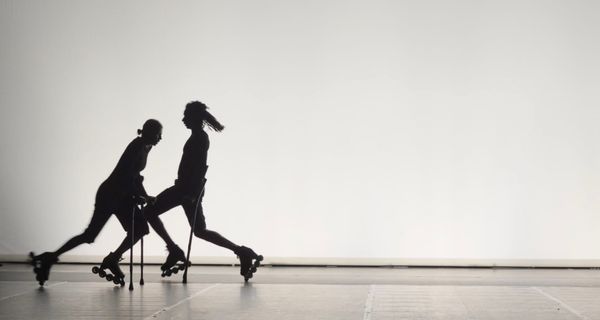
The relationship between body and shadow is the film's strongest visual device. Depending on the angle and intensity of the light, the shadow expands, fragments, or vanishes, at moments it functions almost as a second performer, an unstable extension of the dancer with a presence of its own. Wang uses this to generate real theatrical tension: the performer turns toward the shadow, pulls away from it, occasionally seems absorbed into it. The ambiguity of these encounters, the fear, memory, internal conflict, never named, is where the film earns most of its emotional depth.
The shadow motif is visually striking but dramatically static: it functions almost entirely as tension or opposition throughout, without much change in that role. A clearer arc for this relationship: the shadow shifting from adversary toward something closer to support, or toward a moment of integration with the dancer, would give the ending firmer choreographic ground to land on.
Sound stays restrained: low frequencies, intermittent pulses, extended quiet, all leaving room for breath and movement. Lighting follows the same logic, pulsing to guide attention and shape the film's internal timing. Both contribute directly to the work's rhythm rather than sitting underneath it.
Takeaway
Mo demonstrates Harper Wang's command of choreographic atmosphere and screen composition: frame, camera distance, editing, light, and projected image all working as part of the movement itself. Its most lasting achievement is turning emptiness into an active force: the dancer looks fragile against the scale of the frame, yet every recovery and adjustment accumulates real emotional weight. Endurance in Mo stays unresolved to the end, grown, moment by moment, from a body's decision to keep moving through a space that offers no answer.
ABOUT THE FILM
《漢》 (Mo)
Dance Film | 2024 | 12 min
Creator/Director/Choreographer: Harper Wang
Artistic & Screen Direction: Fang Guan
Cast: Siqi Chen, Yuting Yang
Presented at: 21st Guangdong Modern Dance Week – "Myriad Images (Guangzhou, Nov 2024)
ABOUT THE WRITER
Tianyi Li is a London-based dance artist and educator, blending contemporary, ballet, and Chinese dance traditions. A University of Chichester Master's graduate, she has taught at The Royal Ballet School and Rambert. She is Artistic Director of the London Chinese Dance School and UK-China Dance Association.