Glide and the Rewriting of Movement: Interview with Oktawia Ścibior & Samory Ba
Paris-based dance artists Oktawia Ścibior and Samory Ba on glide, crutches, and the virtuosity of the minimal. Interview by Greta Pieropan.
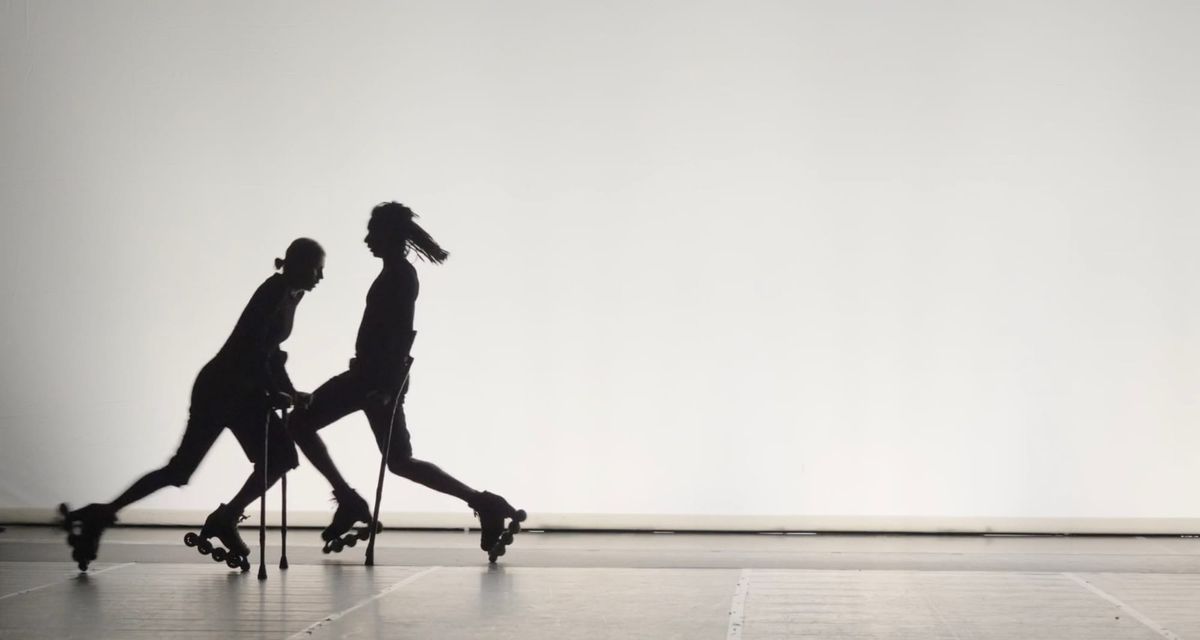
Contemporary dance is having a moment with skating and vice versa, but long before the cultural fascination, Oktawia Ścibior and Samory Ba were already dismantling the medium from within. Based in Paris, both artists have spent more than a decade treating glide as choreographic matter: unstable, poetic, and radically generative.
Their work incorporates dance, performance, and visual art, and has been presented internationally, from La Briqueterie CDCN to the National Arts Centre in Ottawa and the Théâtre de la Ville. The interdisciplinary nature of their work goes beyond crossover into redefinition. Both artists come from competitive figure skating, a world of discipline and spectacle, their move into contemporary dance emerged from years of questioning, and for Ba it began with Le Patin Libre, the Quebec-based company he co-founded in 2010.
Samory Ba: I loved performing, maybe less so competing, but what I struggled with in commercial shows was the lack of freedom and exploration. Co-founding Le Patin Libre in 2010 was the first time I felt allowed to ask: What is skating, actually? What could it be? We didn't know what we wanted, but we knew what we didn't want.
Oktawia Ścibior: The desire to do something differently was always there. I grew up in an artistic environment, and even in competition I looked for small spaces of autonomy. After I retired, traditional shows bored me immediately. Meeting Samory in 2012 opened a new path, not a rupture but a long process of questioning.
Their research took an unexpected turn during the 2020 lockdown in France. With ice rinks closed, they switched to inline skates and began rehearsing outdoors during the one hour a day when moving outside was permitted. The change of medium forced them to reappropriate the glide, meaning owning and using it in a different way, and discovering new limitations and possibilities.
S.B.: Roller skating changed everything. The glide was still there, but it behaved differently, and we had to understand its new physics. That necessity opened a new phase of our research. We introduced crutches, creating a tension between gliding and anchoring, two opposing forces that generated powerful imagery."
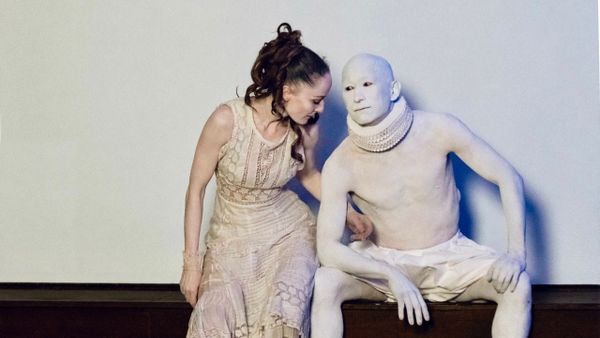
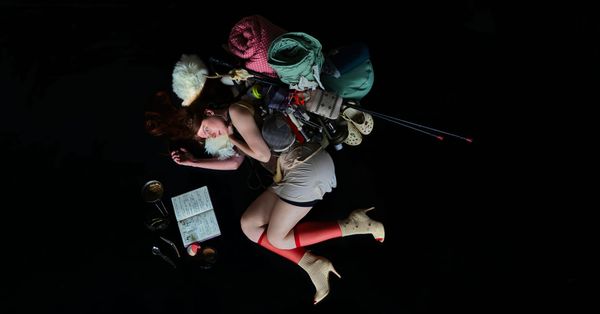
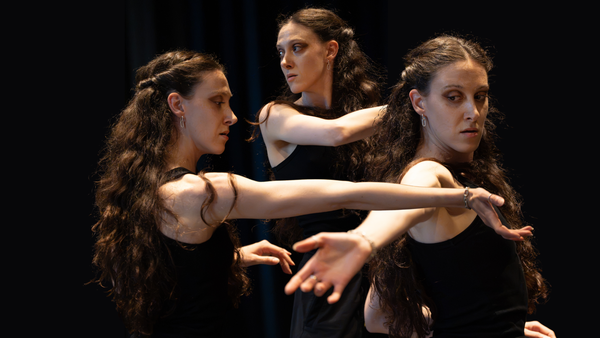
Inline skates and crutches became the basis of Within a Thousand Suns, which premiered in 2024. The work is a duet in three parts about the conscious and unconscious forces that shape how people behave and relate to one another, and about the line between freedom and determinism.
O.S.: At first, it was pure improvisation. But people watching from the windows of their houses responded immediately, giving us feedback and saying the movement felt visceral, animalistic. That encouraged us to continue.
Echoes of figure skating could trap Ścibior and Ba's work under the label of virtuosity, yet the virtuosity they pursue is almost invisible, embedded in minimal gestures that demand extreme precision.
S.B.: Many choreographers use skates for instability. That's interesting, but it's not our direction. We work with a form of virtuosity that is extremely demanding. Pivoting around a crutch while gliding is incredibly difficult, even for professional skaters. A dancer simply couldn't do it.
O.S.: It's virtuosity in the minimal. The audience often tells us the physicality is astonishing even when the movement appears simple.
One of the most compelling aspects of their work is how they treat the skate itself: sometimes visible, sometimes hidden, always conceptually integrated.
S.B.: Glide is both a tool and a constraint. On ice, skates are natural; in a theater, they are not. They look like sports equipment, and we have to consider that. We often ask ourselves: Should we show the tool or hide it? On ice, the tool disappears. On the ground, it becomes visible, and that visibility becomes part of the dramaturgy.
O.S.: The tool must resonate with the work's aesthetic or conceptual layer. It cannot be arbitrary.
S.B.: After performances, we love to do Q&As. Often with Within a Thousand Suns, people say they forget the skates. Because it's presented indoors, with lighting and scenic control, they go further. Somehow, with that proposition, the medium seems to disappear.
And what is the most curious feedback they've received from audiences?
O.S.: The funny questions are always about practical things, like whether we have socks in our shoes.
S.B.: One of the most interesting reflections was about the crutches. Somebody said we had totally inverted the anchoring point compared to skating. In skating, it's your legs; your arms are free. With crutches, the hands become the legs, and the legs are free to move around. I hadn't realized it before, but this inversion is very deep.
O.S.: There was also a comparison to Giacometti's statues in the first part: long, tall bodies.
S.B.: Right! The Q&A helps us better understand what we do. It's great.
Beyond technique and dramaturgy, Ba is now exploring connections between glide and his Senegalese heritage, particularly the rhythms of traditional dances such as the Lamba.
S.B.: There are traditional dances from Senegal and Guinea that have surprising affinities with contemporary movement. I'm interested in exploring those rhythms and how they might intersect with glide. It's a way of reconnecting with something internal and translating it into our medium.
O.S.: I won't be on stage in that project, but I'll support it. It's a new chapter for us creatively as well.
What makes Ścibior and Ba's work distinctive is the way they treat glide as a poetic force that reshapes perception. They strip away spectacle, interrogate technique, and show that movement can be reinvented when the ground becomes unstable. In their work, skating becomes a medium in transformation, discovering how bodies adapt, how they resist, and what new forms of expression they might find in a world that is always in motion.
Interview recorded in Zafferana Etnea in July 2026, during Teatri Riflessi, where the duo presented Entanglement, the first part of their triptych Within a Thousand Suns.
Greta Pieropan has a background in Modern Philology and Literature Studies, with a focus on journalism and live performing arts. She collaborates with festivals and dance companies to communicate dance widely, while researching dance dramaturgy and contemporary narrative forms.