Wayne McGregor’s Alchemies Review: Thinking More Than Feeling
The Royal Ballet’s triple bill at the Royal Opera House is dazzling and precise, but it’s Yugen that warms the heart. A review of McGregor’s Alchemies, from the cool geometry of Untitled to the questions left by Quantum Souls.


I’d like to begin with my unfiltered reaction to set the tone for this story. When I walked out of Wayne McGregor’s Alchemies, I was thinking about it more than feeling it. There was no emotional aftertaste, and I was rather stuck on what I’d seen. That’s a slightly awkward thing to admit for someone who goes to the ballet as often as I do, but I think it’s an honest one, because it truly describes my experience at the Royal Opera House.
I saw Alchemies in the first week of May, 2026. It’s a triple bill combining Untitled, 2023, Yugen from 2018, and Quantum Souls, a world premiere that had opened only a couple of weeks earlier. It was an evening of three very different performances, and three quite different versions of me in the audience.
The evening started with Untitled, 2023, and the first thing that hit me was the color. The green-and-white costumes designed by Daniel Lee for Burberry meet the stark geometry of Carmen Herrera, who kept working in New York until she was well over a hundred. Herrera spent a lifetime proving that a straight line and two colors could be enough, and this was her first and only stage design for a dance production. Personally, I thought it looked terrific, and yet I sat there thinking of synchronized exercises. The lines were so clean and the unison so exact that I was watching the dancers the way you watch a routine that is being judged. I couldn’t stop wondering, “Is it accurate? How do they do that?” The Royal Ballet dancers were astonishingly good, but I couldn’t shake the feeling that I was watching some kind of artistic gymnastics program, not ballet.
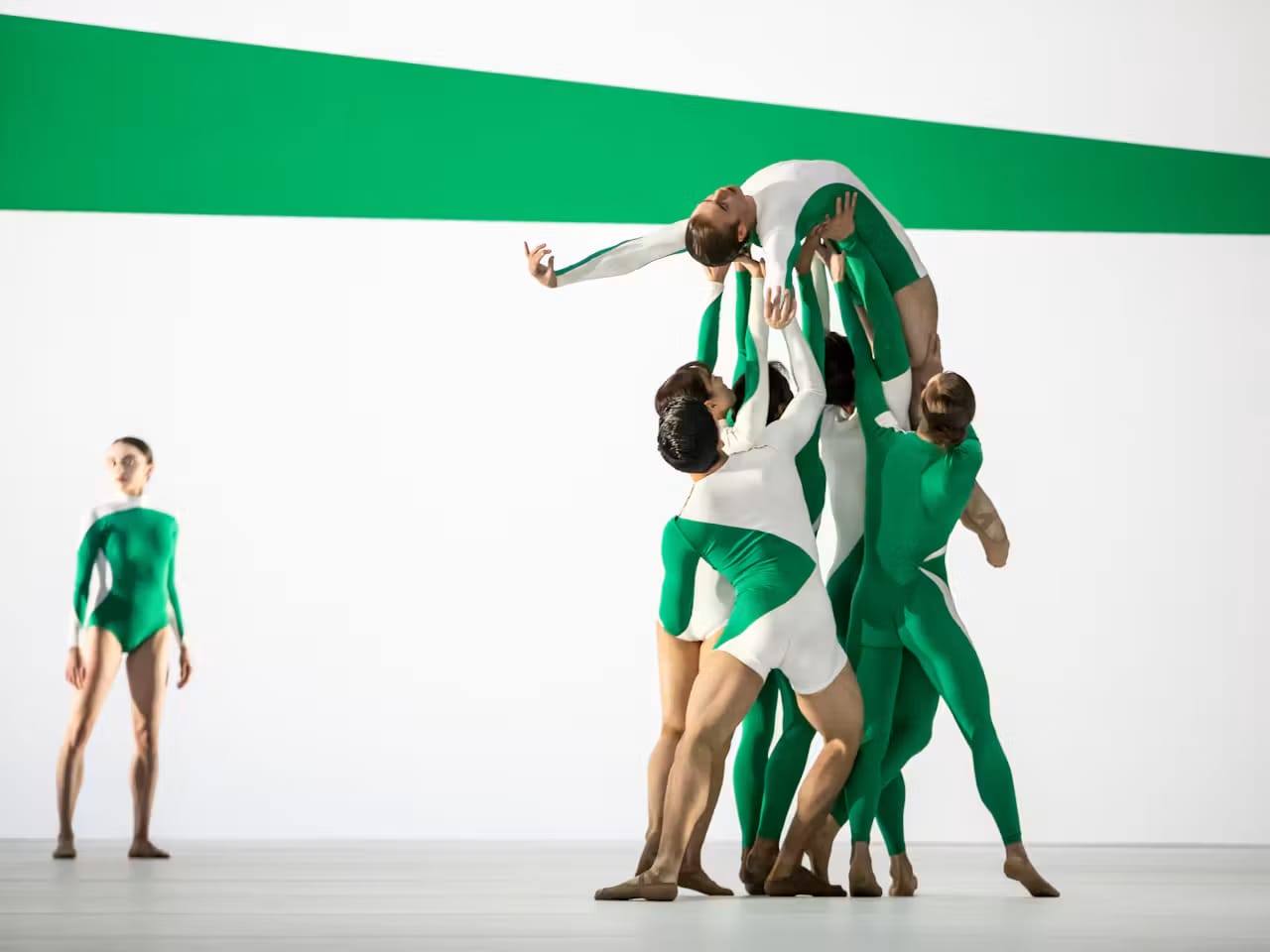
McGregor has been the Royal Ballet’s resident choreographer since 2006. His choreography works like a Swiss watch: it is always meticulously constructed, and yet it constantly catches you off guard. The torso folds and twists where you’d expect it to lift, and the limbs go off at angles, which is exactly what ballet school spends years training out of you. The cast made it look easy, but whatever atmosphere they were meant to create never quite reached me. The green-and-white costumes felt too literal. The choreography had its own logic, and I struggled to feel that everything I saw belonged to the same world. Anna Thorvaldsdóttir’s score didn’t help either. She is an Icelandic composer, and her music is brilliant, like a vast dark landscape that shifts slowly, with no tune to hold on to. I loved it as sound, but set against those bright, sharp-edged figures, it felt as if two different conversations were colliding in the same room. Lucy Carter’s lighting, as ever, was beautiful, and it kept my eye moving around the picture. Still, all that precision was cold comfort for my heart.
Then Yugen arrived and changed everything for me. I think it was the magic of the red, of those deep pomegranate costumes by Shirin Guild set against a design by Edmund de Waal. But it wasn’t only the color that cheered me that time. McGregor made this piece in 2018 for the Bernstein centenary, set to Chichester Psalms, which was commissioned for a cathedral festival and is sung in Hebrew. The moment the human voices come in, something inside you relaxes. The Royal Opera Extra Chorus does here what no orchestra can quite do: it reminds you that real, breathing people are making this happen. That’s what stole my heart that night.

The dancers kept doing very abstract, very difficult things, and they looked like people who were not pieces of the same pattern. I think this is a trick every good choreographer learns eventually. They take the same bodies and the same technique, change the color, and put an idea underneath. The result changes the viewer’s whole relationship with the performance, and it happens before the audience has time to think. Here, the red read well as pulsing blood and strong heat, and I could feel it somewhere around my ribs. The Orchestra of the Royal Opera House was brilliant on the night I went, with Koen Kessels on the podium. He has been the company’s Music Director since 2015. The orchestra and chorus seemed to breathe together, and nothing felt rushed. The music simply held the stage up, and it was one of the few things that evening I had no reservations about.
The last piece was Quantum Souls, with music by Bushra El-Turk, a British-Lebanese composer, written for percussion and strings. The strings were in the pit, while the percussionist Beibei Wang played live on stage behind a wall of instruments, alongside double bassist Tony Hougham. The dancers moved around them on a bright yellow floor, in blue-gray and yellow costumes by Saul Nash. Everything Wang did was physical, her whole body leaning into the strike, and she moved from instrument to instrument almost like a dancer herself. I could see the sound being made a fraction of a second before I heard it, and that tiny gap is quite magical to catch.
I had also watched the Royal Opera House Insight discussion before going, and it answered a lot of my questions. McGregor talked about leaving room for the dancers’ choices in the last piece. He hasn’t tried to fix every moment, so El-Turk’s score has room in it for variation. Wang described watching the dancers and deciding, in the moment, how to respond to them. McGregor also said he imagined a huge yellow floor as the piece developed from the music. So in Quantum Souls, the music came first and the visuals followed. In the end, I wasn’t entirely sure why I wasn’t drawn in. I knew the piece changes a little with every performance, and that is exciting. I could appreciate the attention the dancers had to pay to each other and to the music. But I felt oddly detached watching it, and the emotional part never quite came to me.
McGregor once made the point in an interview that we often ask what dance means, but perhaps we should simply watch the movement and notice how it makes us feel. I agree that dance doesn’t always need to tell a story. But I’d add that leaving a work open is not the same as pulling the audience in. You don’t have to explain everything, but even beautiful, clever work can leave an audience feeling distant and lost. Even though I had mixed emotions after the performance, it stayed with me for a while. The experience taught me that a response is a collaboration between the stage and whoever happens to be sitting in the room that night. Yugen was my favorite, and the other two left me with questions, and that’s perfectly fine.