Kueyen: Rethinking Tango Through Contemporary Dance and Mapuche Cosmology
By Will McGregor –– In a work-in-progress at South East Dance, Anna Alvarez and Pablo Cortazzo challenge traditional partner dance with ancestral myth and female presence.

by Will McGregor
When we watch a classic tango piece, we expect a familiar promise of two bodies, one shared center, and a clear exchange of weight and attention. In today's fast-developing dance scene, that is no longer the whole story. At South East Dance in Brighton, I recently saw Kueyen, an intercultural dance-theater work shown as a work in progress, and it mattered more than I expected. It was still looking for its own language, yet it already seemed to know exactly what it wanted to ask. The performance revealed the depth of the collaboration between Anna Alvarez and Pablo Cortazzo, whose complementary approaches allowed Tango to explore new shapes.
I went into the theater expecting tango to feel familiar, and at first, I kept searching for it, its intimacy, the connection between moving bodies, what I recognized and what I didn't. But the more I watched, the less I needed to place the movement in a known category, and the more I could simply take in its emotions, its atmosphere, and the questions it raised. There was something fulfilling in that process. I had room to find my own way into the work and decide what its ideas meant to me. That is where Kueyen becomes unique, because it takes something I thought I understood and gently opens it into a much wider emotional and cultural space.
The concept behind the production is simple, and it’s about how much story can tango hold once it is freed from the usual "tango show" boundaries. Instead of using the form mainly for technique, romance, or spectacle, Kueyen treats tango as a way of telling a story, placing it in dialogue with contemporary dance, theater, and Mapuche cosmology. That approach gives the performance its most interesting tension, because tango arrives with a long history already encoded in the body, including its particular relationship between lead and follow. Yet, the team is not content to just add modern moves to tango. They take the old rules seriously but want to ask whether those rules can tell a new story. That is a harder job, and it is why I see Kueyen opening the form from the inside.
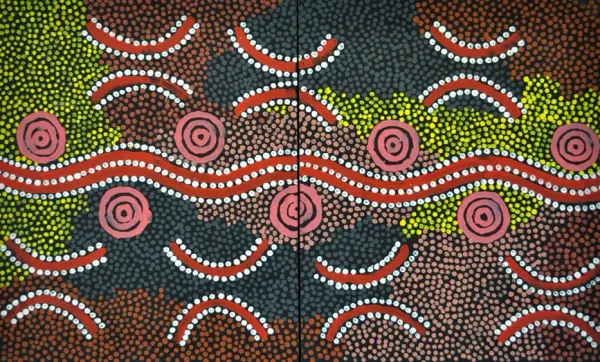
The title is the first clue. "Kueyen " is the Mapudungun word for "moon," and in Mapuche belief it is also a spirit, a female force of creation tied to night, tides, women's cycles, time, and ritual. Its counterpart is Antü, the sun, and together they represent a balance between female and male. This matters because Kueyen does not lay Mapuche cosmology over tango as an aesthetic layer. According to the company, the research involved direct engagement with Mapuche communities in Argentina and with elder women from community organizations in the UK. That very grounding shapes the work's interest in female power, heritage, and belonging, and it is a more serious foundation than the familiar contemporary-art gesture of borrowing Indigenous symbols for atmosphere.
The work's cosmology is as ambitious as its dance vocabulary. Mapuche thought divides existence into three sacred territories: Wenu Mapu, the upper realm; Nag Mapu, the earth where we walk; and Minche Mapu, the world below. In Kueyen they become living ground beneath the dancers' feet and spaces the choreography inhabits, so that cosmology stops being a concept and becomes a place. At the heart of the piece sits Peuma, the dream, a shimmering channel between worlds. From it comes the work's most daring idea, the "Third Space," the charged opening between tango's two vertical axes. Kueyen questions what happens when that space becomes a territory of its own, thick with culture, politics, and myth. Tango has always been preoccupied with the dialogue between two people, but in Kueyen the stakes shifted and I’d say sharpened. Now, the audience is left with a new set of questions: Who gets to lead? Who gets to dream? Who gets to be seen? And who, finally, gets to write the history of the dance itself?
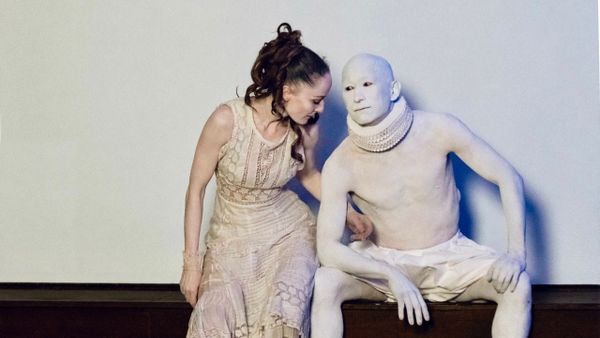
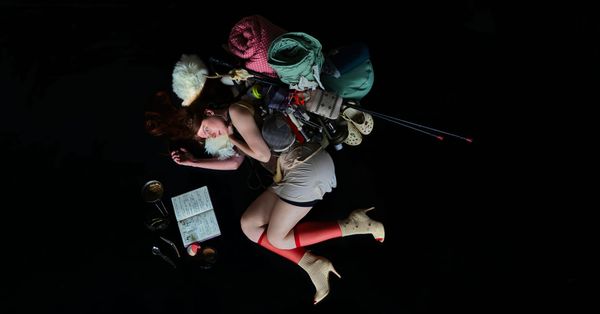
Those same questions shape how Kueyen represents women on stage. The piece pushes back against the tired image of the female tango dancer as a high-heeled cliché of seduction, confined to prescribed partnering roles. Here, a woman can be an author, a leader, a keeper of memory, and a political presence in her own right. Tango, like many art forms, has long presented one fixed face toward gender, and the history is far messier than that. In this performance, the glossy image that commercial stages have sold for decades is openly challenged.
There is no conventional plot. Kueyen is a conceptual piece, introduced to the audience through the program and leaflets, and what follows is a journey around its central idea: female energy, ancestry, identity, and the relationship between different worlds. What we see and feel is left open to our own knowledge and experience, and the work does not dictate a single meaning or story.
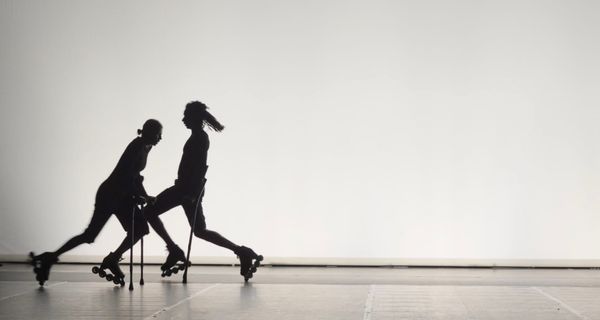
The ensemble reflects the same breadth. The five dancers (Carolina Giannini, Cristina Cortés, Hannah Beltram, Gabriela Solano, and Maeve McGreevey) come from very different movement worlds: tango, contact improvisation, contemporary dance, Orisha dance, and hip-hop. That mix could easily collapse into shallow "fusion," but under Alvarez and Cortazzo's guidance it becomes an act of translation, in which each tradition carries its own hidden rules about rhythm, weight, gesture, ground, and touch. Cortazzo told me that editing was one of the hardest parts of building the piece. With so much material and several histories at play, knowing what to cut matters as much as knowing what to create, and intercultural choreography turns to clutter quickly. Restraint, in that setup, becomes an artistry of its own.
The design carries this instinct further. Carolina Rieckhof's central image is the Ruka, the traditional Mapuche dwelling, rethought as a portable structure that can hold an audience inside it and let the piece move between gallery spaces and black-box theaters without locking it behind a frontal stage. I find that suitable for a work so preoccupied with shared territory. The audience is not parked outside looking in but placed somewhere to dwell, which blurs the line between performer and witness. Another part of the creative process that made me enjoy the performance was Santiago Jarra's score, composed from scratch, adding to the sense of a world of its own. It never feels like borrowed shorthand for "tango."
Kueyen shows no interest in preserving tango behind glass. It is searching for what remains unmistakably like tango when the form is placed in conversation with contemporary dance, theater, ritual, and Indigenous cosmology. For me, the strongest moments came not when tango was most immediately recognizable but when its physical logic survived after the familiar elements had been stripped away.
This is where the pairing of Alvarez and Cortazzo shows its strength. Alvarez, founder of Anna Álvarez Compañía, brings the wider contemporary lens and an openness to different movement traditions. Cortazzo, who grew up in Buenos Aires in a family of musicians, with a Tango musician as his father and the respected milonguero Osvaldo Natucci as his uncle, brings tango experience from the inside. His contribution is clearest in how tango remains in the piece even as the dancers move beyond conventional partnering: physical responsiveness still organizes their relationships on stage. He does not set tango beside contemporary movement as a separate style; he lets the principles of tango choreography travel into a different physical language. That gives the intercultural material coherence, and it takes more than technical familiarity. The result is strongest in the quieter exchanges, where the principles of tango can still be sensed and the embrace becomes a way for the dancers to explore closeness and trust. In this direction, the "Third Space" is something we can see and feel, rooted in Cortazzo's knowledge of tango and expanded through Alvarez's contemporary approach.
Recalling Germán Cornejo's Wild Tango at the Peacock Theatre in 2022, the comparison is instructive. Where Cornejo pushed tango toward circus and spectacle, Kueyen takes a more reflective route, using the language of tango to explore heritage and identity. There is a touch of In the Room (2021), the first chapter of the Argentine-Austrian Tango Tanz Trilogy, too, but Kueyen opens the form further, toward art and belonging.
The work is still evolving, and that is the right way to encounter it. The Brighton sharing, part of South East Dance's Rough Cuts series, took place on June 26, 2026, and lasted one hour. It was part of a "soft-touch" development process that also included an excerpt at Sadler's Wells East the next day, with the aim of listening to audiences before the work grows into a wider touring project. The project has received funding from Arts Council England, and a wider tour is planned for 2027-28, including a spring 2027 residency at Sun Pier Gallery in Medway.
That context changes the question of judgment. At this stage I would not expect every transition between the work's many systems to be resolved, and the absence of final costume and set design should not be mistaken for an artistic deficiency. What matters is whether the work has an artistic identity strong enough to justify further development, and Kueyen does. Its strongest idea is not simply that tango and contemporary dance can be combined, or that Indigenous knowledge can enter contemporary performance; neither is new on its own. It is that tango itself might become more spacious by being asked to remember histories and relationships that commercial representations have often left outside the frame.
I left Kueyen thinking less about whether it had successfully "fused" its influences than about whether it had found a reason to bring them together, and I think it has. The work has a clear, distinctive cultural and artistic framework and a collaborative movement language that can still be refined. What I find most promising is that it does not treat tango as something that needs rescuing from its history. It asks what might happen if that history were opened up. What if the embrace could hold memory, migration, land, ancestry, gender, and the possibility of another future, and not just two bodies?
Creative team
Choreographer: Anna Alvarez
Assistant choreographer: Pablo Cortazzo
Dancers: Carolina Giannini, Cristina Cortés, Hannah Beltram, Gabriela Solano, and Maeve McGreevey
Composer: Santiago Jarra
Producer: Madeline Wilson
Dramaturg: Xenia Aidonopoulou
Design: Carolina Rieckhof