Choreographer Sofia Greben Tracks Migration Through Muscle Memory in "kösh"
Ahead of the premiere of kösh, Hamburg-based dance artist Sofia Greben breaks down her somatic practice, club culture influences, and the concept of nomadic movement.
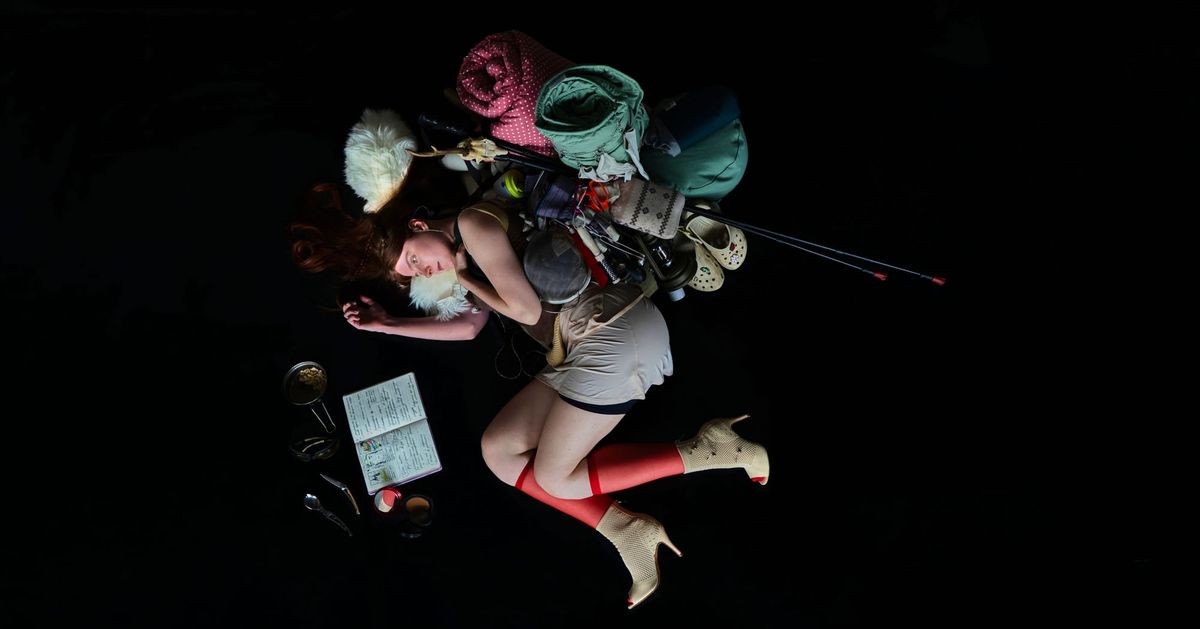
When we think about migration, our minds probably go straight to paper – travel documents, dates, coordinates, border stamps. In contrast, Sofia Greben tracks migrations via muscle memory. Working from a foundation of somatic improvisation, the Hamburg-based artist has refined her piece kösh over six iterations. It explores the concept of nomadic movement as understood in Kazakh language.
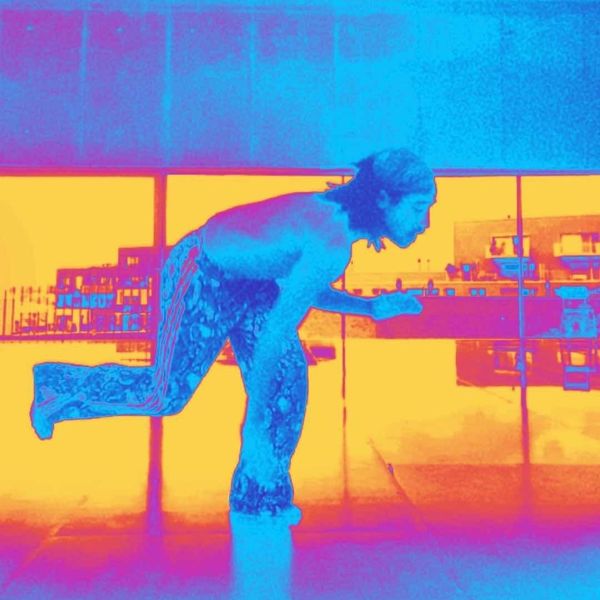
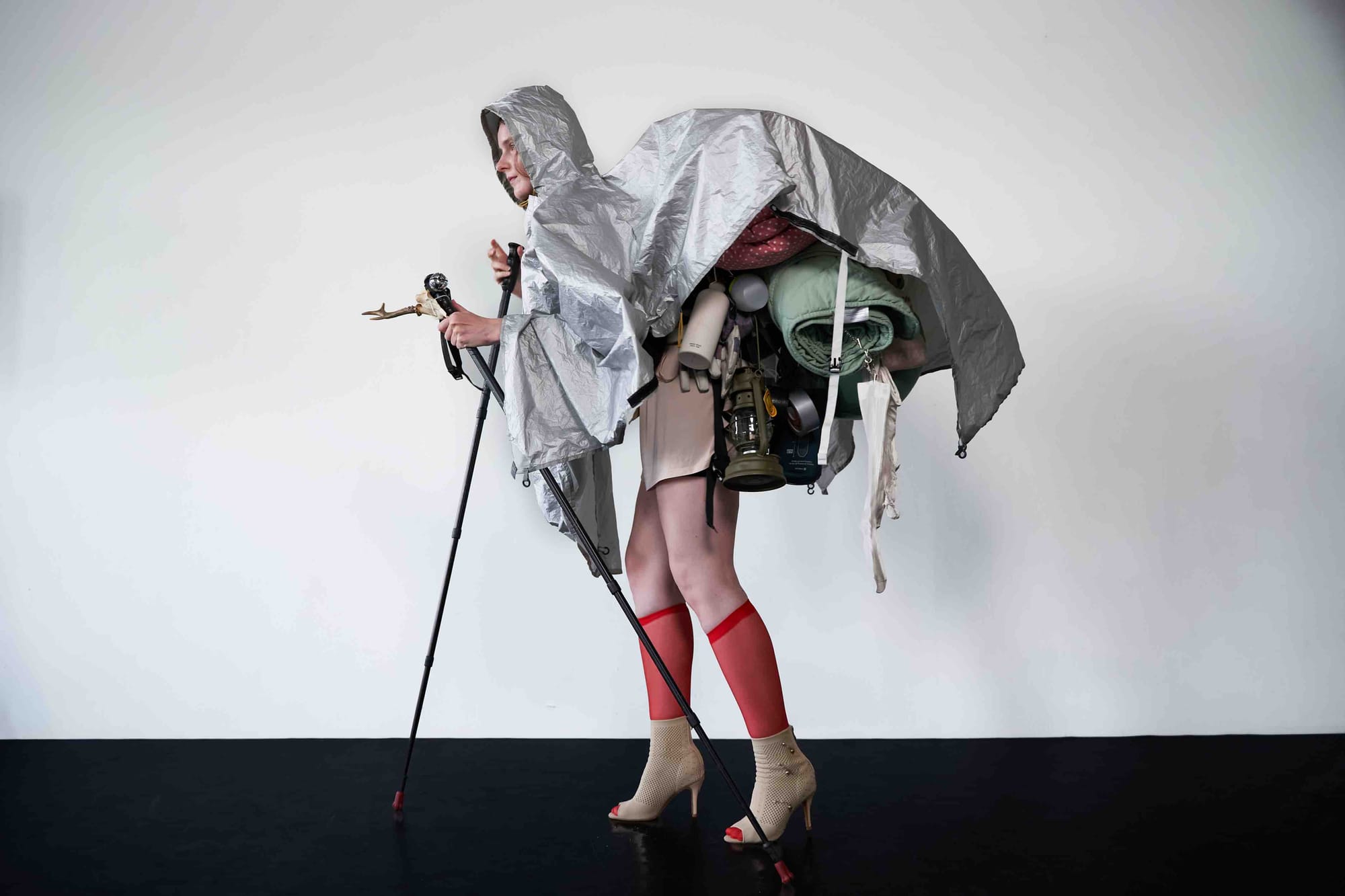
Onstage, these memories manifest themselves physically. Sofia’s hiking stick strung with bells echoes the Kazakh asatayak. Her raincoat morphs into a makeshift tent. And even her heels reference the stages of Astana, the city where she started performing when she was ten. Her hair, too, tells a story, it moves “on its own,” as if possessed by some otherworldly energy. Each item draws a different chapter from Sofia’s bodily archive, from Kazakh folk dance to the go-go and club scene of her teenage years, up to the contemporary and somatic training that transformed her body.
On the cusp of the piece’s official premiere on October 16, 2026, Sofia discusses some of the tension between her different influences, why it’s important to show an unfinished piece of art, and what it means when you carry your entire world on your back.
You describe the body as a living archive, when you look in it, what surprises you most, a memory you did not know was stored or one you had deliberately buried?
When I work with the body as an archive, I find something new that reveals itself every time, something I had not noticed before. For me, this process is also a form of self-recognition: recognizing my own experiences and the value of all the traces that exist within my body. In my work kösh, I returned to my personal archaic movements that had been forgotten or pushed into the background. What surprised me was discovering how natural and familiar they felt. Through different contexts and experiences, some of these movements became less visible, but when I returned to them, I realized how naturally they were still living in my body. They felt like “mine”. This also brought me to the question of what feels like “mine” and what does not: how deeply a movement has entered the body, how familiar it feels, and how it becomes embodied. I was especially interested in reactivating these deeply rooted movements and looking at them again through my current body, through contemporary knowledge and through the influence of other dance cultures. Bringing these movements from my past into new places and contexts I arrive also changes them in a way, allowing them to exist in a new environment and resonate differently. For me, the body as a living archive is not something fixed. It constantly reorganises its past experiences while moving forward, accumulating new layers that eventually become part of its history.
"Dances migrate between places, cultures, bodies and generations... What interests me is allowing all these layers to coexist. I don't necessarily want to resolve the friction between them."
Kazakh folk dance, club culture, somatic practice, contemporary dance, do these influences coexist peacefully in your body, or is there friction between them that you have to choreograph through?
I think it is both. There is a friction, but there is also a surprising harmony between these different languages in my body. For example, I discovered that the very strong physical vocabulary I developed through Kazakh traditional dance, especially the softness and expressiveness of the hands, could flow quite naturally into club and feminine dance forms. When I was younger, I danced in a female collective where we danced go-go, heels choreography and were influenced by different styles that were coming from the West into Kazakhstan, such as voguing or waacking. I realized that these techniques were not as separate in my body as I had imagined. In fact, I have been dancing in heels since I was ten, representing femininity through different dance forms on stages in Astana. Later, my body changed through contemporary dance, somatic and release techniques. So when I return to these earlier forms now, I am not returning to the same body that learned them. I am performing them through a body that has learned to listen differently to weight, sensation, impulse and effort. This is where I think the friction appears. The original form becomes distorted or transformed simply because the body performing it has changed.
There is also a question of what we call “traditional” in the first place. The Kazakh dance I learned was already a stage form shaped and transformed during the Soviet period; it was not the original form of folk dance. This made me question the origin of the movement in my body: what is the origin of this dance, how has it migrated, and how has it been transformed? I became interested in how other dances also migrate to Kazakhstan and change the cultural and physical landscape there. Dances migrate between places, cultures, bodies and generations, and they change as they move. So I am returning not to an original movement, but to a movement that has already passed through different historical and cultural layers. What interests me is allowing all these layers to coexist. I don't necessarily want to resolve the friction between them. I want to see what happens when I reactivate them in my present body. Me dancing Kazakh dance when I was ten is different from me dancing it now. It becomes something different from what it was, while still carrying traces of where it came from.
It’s called ‘a solo’ but we see this piece develop into a shared space. What kind of role does audience play here? Are they there to receive, to reflect, or to complete the journey?
Yes, the solo unfolds into a shared space with the audience. The boundaries between the stage and the audience are deliberately blurred: they are positioned around the performance space, but at the same time they become part of the environment I am moving through. During the solo, I move between the audience and sometimes beyond them, stepping outside their circle and shifting the perspective of the space. It was important for me to create a sense that we are all inhabiting the same environment, almost as if we were in nature, with this nomadic body moving through it and all of us becoming part of that landscape.
I think of the audience as active witnesses. They witness my transformation and this kind of dance ritual, where I open different portals into my embodied archive. Their presence also helps to activate the space and my own presence within it. There are moments when I become very aware of individual people, look directly at them, or consciously direct my gaze and, through it, their attention. So their presence is not passive, they become part of the conditions in which the journey happens. The attention can move between us, almost like another form of nomadic movement within the space.
"For me, the body as a living archive is not something fixed. It constantly reorganizes its past experiences while moving forward, accumulating new layers that eventually become part of its history."
What were some choreographic decisions you made to communicate this “carrying your whole world” concept physically? In terms of using those physical pieces – are they more about burden/anchor or extension?
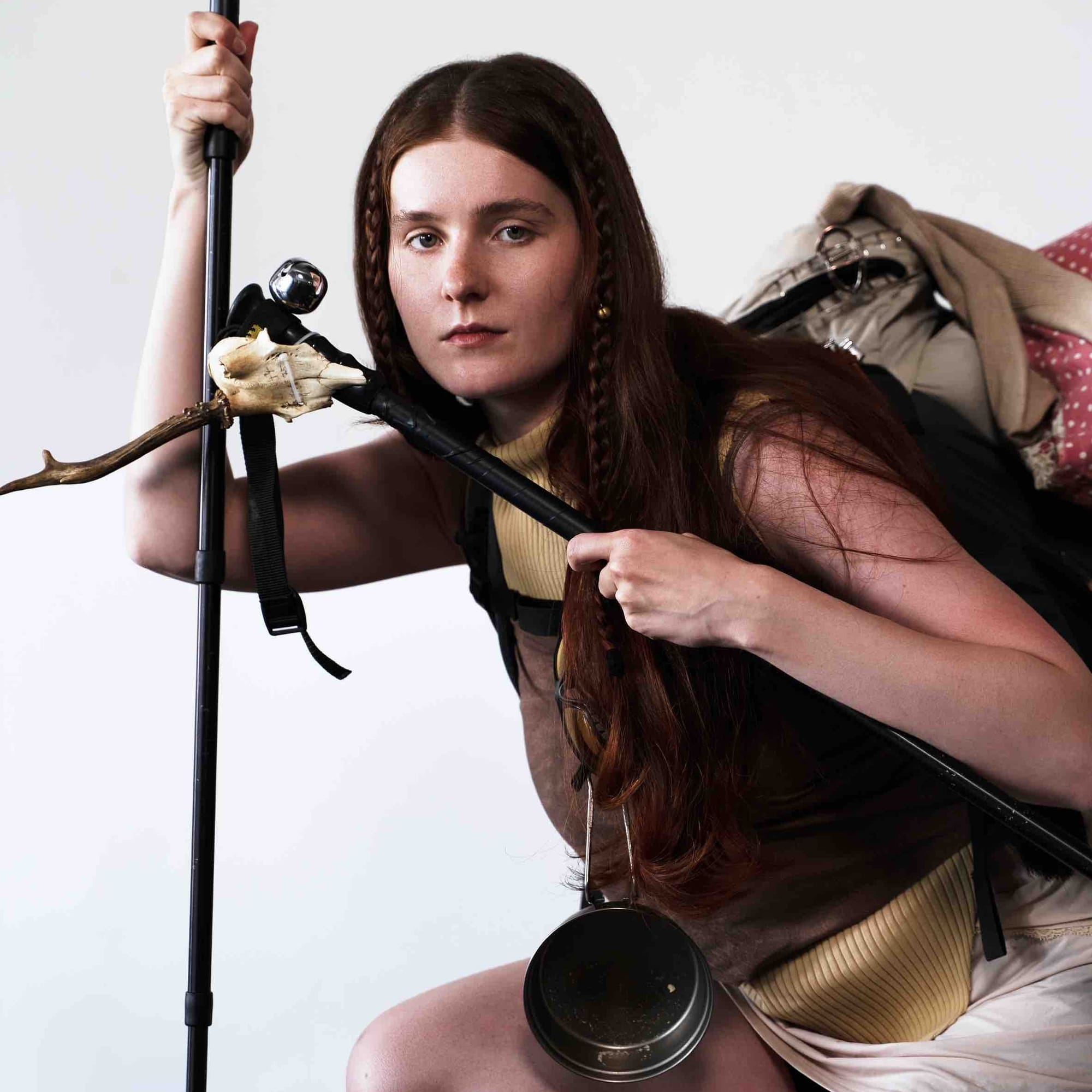
In the performance, I combine choreographic practices with practices of working with objects. The objects I use are connected to the idea of the contemporary nomad, but I also try to make some of them somehow archaic. I work with a hiking stick and bells, a raincoat-tent, heels, and my hair as an object. For me, these objects are portals into different worlds, opened in different places within the landscape of the performance.
The stick, for example, has a reference to the Kazakh asatayak, a musical instrument made from a stick or staff object and decorated with bells. This reference and practice were brought by a sonic artist Lovozero, who developed a soundscape for the piece. At the same time, it can be a nomad’s or witch’s staff, a musical instrument, or even a go-go pole. It holds many different archetypes within one object, changes the distribution of the weight and body orientation in space. The bells on my body also announce my presence in space. The raincoat transforms into a shelter, a tent. It creates an image of a home, protection, or a place to hide, but it is also a piece of material that I can move through space and choreograph with. It becomes both a shelter and part of the landscape. The heels connect me to a go-go body. They change my relationship to the floor, my balance, and open another kind of feminine dancing body. My hair opens a portal into go-go dance archive and femininity, it also becomes a kind of whip and develops its own agency. I was wondering whether I am moving the hair or the hair is moving me. It becomes a sensitive material, almost like an antenna, activating different sensations in the body. In this sense, the objects open different layers of worlds that I am trying to encounter and embody through different bodies in the performance.
Kösh’s had at least six public iterations prior to tonight’s premiere. How much has changed from when it premiered initially? Was there a version you threw out completely?
Every work-in-progress showing was completely different from the others. A big part of the process for me and a dance dramaturge, Anna Semenova-Ganz, was searching for the structure and trying to understand how a structure could exist within a nomadic concept. Some versions were built almost entirely through improvisation, while others had more anchors, fixed moments, and grounding. My task was to eventually arrive somewhere, to give the work and the choreographic material a clear form, while still allowing it to breathe within that structure. Across the different iterations, I also focused on different parts of my movement archive. At some points I worked more with objects and materials, at others with Kazakh dance or go-go and the different bodies that emerged from these practices.
For the premiere, I am bringing this material together and placing these sometimes very different bodies next to each other, making the transitions between them visible – how the body moves into different states. The project itself transformed quite a lot. At an earlier stage, I worked much more directly with migration as a search for home and identity. I worked with domestic objects, different forms of portable homes, and spent some time exploring the yurt. So there are elements from those earlier versions that I have completely left behind. What interests me more now is the idea of the nomadic subject: a body that carries the traces of transitions and is itself fluid and constantly changing. The work has gradually moved towards the body as a place where these traces meet and are continuously reassembled.
"My hair opens a portal into go-go dance archive and femininity... I was wondering whether I am moving the hair or the hair is moving me. It becomes a sensitive material, almost like an antenna."
Christopher Matthews’ contribution was as the “outside eye”. Can you think of anything he caught sight of in your work that you couldn’t see for yourself?
I met Christopher at the ImpulsTanz festival in Vienna, where he was my mentor during the ATLAS programme and research residency. With Christopher and a group of other mentees and artists, I was able to redirect the focus of the work. At that time, I was revisiting my go-go archive, working with the deconstruction of the go-go body, the sexualized female body, and the politics of the gaze. He helped me rethink the material from different perspectives and translate the political discourse into choreography. His belief in me as a mentor helped me see my body as a source of power, including all the layers and experiences it carries. This influenced my choreographic decisions, finding ways to ground the research material and allow the body to arrive and move through different states and places within the archive.
What’s ‘finished’ for you in terms of this kind of project? Does the premiere close a chapter, or will Kösh be moving on to other things post-October?
To be honest, I am still interested in finding out what “finished” means after the premiere. This is my first solo work, so it is also the first time I am going through this process of taking something from a research phase into a fully developed stage and choreographic work. I don't know if this process can ever be completely finished. But at the moment, it does feel as if the work is coming towards a completion. The process of working with this material, this subject and these questions feels like it is reaching a certain point of closure.
At the same time, I feel that kösh is opening another step into the future. The nomadic subject is always in the process of becoming something else. The body within the work remains porous, responsive to its environment, to the space where it is performed, and to the people who enter it. So perhaps the premiere allows the work to arrive and fix certain moments, while still allowing it to remain porous and alive. I don't know yet whether kösh will continue moving after October, but I think the body within it can continue becoming.
Perhaps that’s why kösh provides no clean-cut answers, no satisfying conclusions where things settle down into some kind of equilibrium.
Instead, by showing us how she treats her own body as a porous surface constantly being reassembled, Sofia encourages us to think about our own relationship to our pasts. While the performance is definitely a milestone on the calendar, it is clear that this particular journey isn’t over yet. Neither are her travels along her spine.
kösh premieres at LICHTHOF Theater, Hamburg, Germany, on October 16 and 17, 2026.
For future dates, keep an eye on Sofia's website or find her on Instagram.