Gold Pylon: Orality, Womanhood, and Sacred Tales at La MaMa Moves!
Ana Biagi surrenders to the spell of Jade Charon Robertson’s transformative piece at the 2026 festival.
by Ana Biagi
I went to the La MaMa Moves! Dance Festival 2026 in New York. I chose to see Gold Pylon, a multimedia dance piece by choreographer and director Jade Charon Robertson, not only because it fit my schedule but because the image and words presenting it on the flyer simply wouldn’t let me go. The flyer was a small performance piece in its own right. It created an atmosphere of approach that resonated with my intuition, something akin to the mirroring that sets itself in motion when we choose this way, flying blind: a dance of the imaginary that instantly begins its performance.
"I tried to keep control of the game of seduction between me and the stage, but the piece doubled down on its bet, and I frankly surrendered."
I had read that the piece was concerned with empowering Black and Brown people, and with womanhood, spirituality, ancestry, kinship, and the powers that emerge from ritual. That proposal left me feeling small. I tried to keep control of the game of seduction between me and the stage, but the piece doubled down on its bet, and I frankly surrendered, devouring the meanings of what was happening.
Some time has passed since I saw it, and I am writing this text from its lingering glimmers, which I intend to weave into a plot, composing a work of glimmers from a work. It would be like stepping in and out of a spell. And it feels right that way: letting time do something with those impressions, and letting myself do something with the absences and with time.
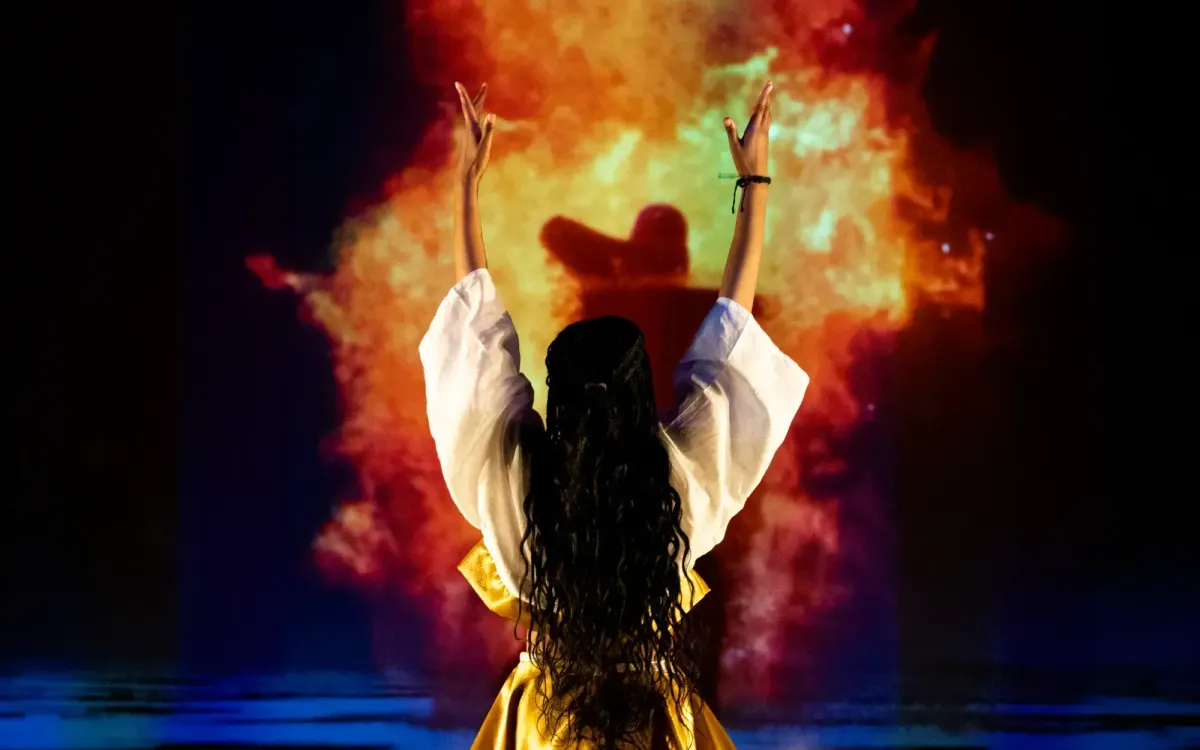
On stage there is a screen, and on it I see fire. A dancer enters dressed in red and gold, moving in an enveloping way, with the kind of delicacy that can kill, a caress capable of shaking you. Four dancers dressed in white and gold enter the space. There is a profound presence, or presences: not only theirs, not only ours, the hungry spectators; there is more, somewhere.
"A ritual act unfolds in which the bodies arrange themselves to offer more than a dance."
A voice narrates a story. A ritual act unfolds in which the bodies arrange themselves to offer more than a dance. I play along with my listening in English, with what I understand and what I leave incomplete, driven by a visceral need to flirt with the mystery of something perhaps possible and entirely unknown.
I loved everything that was taking place, especially because there was also voice. Beyond the fact that dance has its own dramaturgy, there was a dance with words. The voice appeared as an instrument of the dance, and the whole ensemble composed a powerful and harmonious score. At the same time, there was an internal sequence of dance: my own dance of translation, of interpretations, of omissions, and of the resonance of words.
The texts circulating in the scene summoned memories, past tales, the affects of each unique history. When does a tale become a sacred prayer? How do subjective and collective inscriptions find a body? How much does the sacredness of those words weigh upon a body? How much does it elevate it? They were bringing something from somewhere; they were medium-dancers, dancing from the flesh to the fleshless, stripping the body bare of a corporeality that can glide through time and through the multiplicity of contexts it inhabits.
I imagined that those prayers and sacred tales took on such density in those bodies that they made them collide, as if they were stars entering into friction, leaving particles of their meanings floating in the air.
Tales are the oral tradition of a community: that which constitutes collective identity and subjectivity, that which remains despite and along with time. Tales are like a house being prepared to receive what is to come; it contains the scene of transmission. What is said is just as important as who says it and to whom.
Each dancer danced, looked at us, and spoke a text. There was an implicit invitation to step into that space with your eyes, as if they were asking the soul, for just a few seconds, to untether from the bodies present, enter the scene, and travel into a before, within each unique history and within the shared one. Any intention of tying linearity to time evaporated. They hosted us with some familiar memory and placed us, in that way, within a map of our own affect, which now belonged to us all.
The African dances erupted, shaking all structures, material and invisible. The strength penetrated the freshness of the smiles, the depth of the movements, and the suspicion of past sorrows.
"I believe that tales die every time they are repeated; they need to die as a condition of their existence, just as every entrance onto the stage is a death."
We entered their narratives through orality and dance. Dance became a sacred text, immaculate and a transgressor of time. It became defiant, covered in the mud of reclamation and insistence, full of folds to unfold in rituals, inscribing words that can shape destinies, ignite, open portals, and leave gold dust suspended among us.
I believe that tales die every time they are repeated; they need to die as a condition of their existence, just as every entrance onto the stage is a death. That is the power of stories: being able to die, to appear at another moment and in another time, to become production and become dance.
I looked up pylon. I wanted to know its meanings beyond “gate,” and what else I could do with them and with my experience of the piece. One search result referred to the architecture of ancient Egypt, where a pylon is the monumental entrance to a temple; another referred to a high-voltage tower. I later learned that Charon’s research included time in Egypt, where she studied the gold pylons framing temples. I also looked up gold, wanting to know its properties outside of its common representations. I could turn this text into an endless free association about gates, powerful metals, time, the bonds we harbor, the bonds we have never known, the words that took the shape of compasses, and those that, through an erosive effect, turned into something else. But I am going to end it here, describing the encounter with dance (or with dancing?) as going toward a golden gate to open it and coincide with an open history.
I wonder if behind every golden gate there will be a dance that can become history, or if there will be a history that becomes dance.
Creative team
Director and choreographer: Jade Charon Robertson
Dancers: Gabrielle Loren, A’shey Clement, Shania Jones, Janae Moses, Ayana Williams
Music: Farai Malianga
Visual designer and technologist: Ker Chen
Performed April 17-19, 2026, at The Club at La MaMa, as part of La MaMa Moves! Dance Festival.
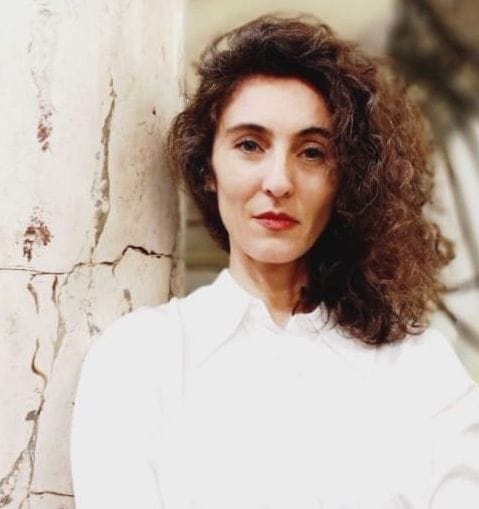
Ana S. Biagi is a contemporary dancer, performer, psychologist, and dance writer based in Buenos Aires. Her professional practice bridges clinical psychology, institutional work in social public policy, and the artistic performing scene.
This article was originally published in Spanish at Cuadernos De Danza.