Waro, the Bastard Hero
At a world music festival in Norway, a chance encounter with a Réunionaise Grandmaster becomes a meditation on hybridity, belonging, and the labels we use to contain each other.

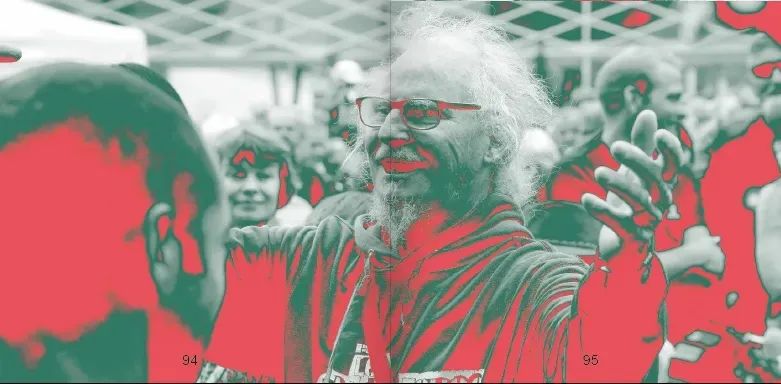
“Do you know the man sitting to my left?” Béla asks.
I see a little man with long white hair sitting on a couch in the hotel lobby, being interviewed by a press person. No, I say, I do not know him.
“You should!” Béla replies, his eyes sparkling with admiration, “C’est un Grand Maître” — he is a Grandmaster.
For the past two days Béla and I along with 13 other international media delegates have spent time hiking, kayaking and riding buses across Norway. I already knew by then that Béla, a middle-aged, Guinean-French music expert, has a sharp critical sense when it comes to his subject. For him to call someone a “Grand Maître” with awe means that person must be a prominent figure in the music world. Intrigued I ask for his name. “Danyèl Waro,” he whispers with pride.
Embarrassed at my own lack of music knowledge, the next day I decide to join a “Meet the Artist” session run by the festival alongside its concerts program. Forde World Music Festival is an annual event held since 1990 in the small town of Forde on Norway’s western coast. The theme of this year’s festival is “Dance in Music, Music in Dance”, which means a lot of correlating genres of music and dance explored side by side. Meet the Artist sessions are, as the name suggests, meetings between the audience and guest artists, usually held in a cozy room next to the library at the Førdehuset cultural center.
Waro’s session is facilitated by Valerio Corzani, a witty Italian radio anchor, journalist and musician from Rome together with a Norwegian interpreter. The audience look very attentive; their bodies slanted forward, eyes fixed on Waro, who sits with a straight spine in the middle of the room looking like a tiger. Valerio’s questions show an extensive familiarity with Waro’s career and background. Waro’s replies are lengthy, full of unfamiliar musical terminology, the complex history of a peculiar geography and its equally complicated politics, all of which made the interpreter’s job somehow uncomfortable.
On our way out, Valerio and I stand near the main gate while he unlocks his bike. I have many questions on my mind, but only one felt urgent. I am unsure whether it is a politically correct question, but decide to ask it anyway: “Why on earth does Waro speak like a black man when he couldn’t possibly be more white?”
Valerio looks at me for a minute trying to formulate a coherent sentence. “Well, it’s complicated,” he says. “La Réunion is complicated.” His eyes fizzed with the same admiration I saw in Béla’s the day before, and he adds: “Waro was imprisoned in France for almost two years for refusing to wear the military uniform.” His sentence becomes something else on impact. To me it sounds like: “The man is a hero!”
So, the little white man is an African music master and a hero. And later I discover that he takes pride in being called a “bastard”. This puzzling combination piques my curiosity even more. So I decide to follow Waro around.
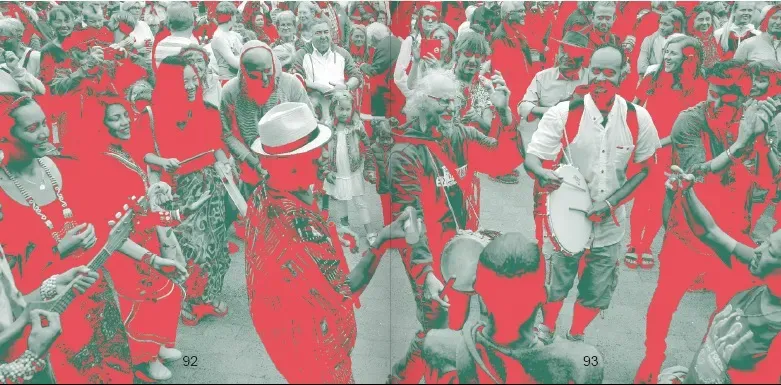
Two hours later Waro’s first concert starts. Within 20 minutes the hall and the balcony are jammed. You can feel the space gradually heating up. Waro starts sweating while singing, dancing and playing the Kayamb – a handmade musical instrument made out of sugar cane that I have never seen before. I am astonished to find the audience singing with Waro, since I cannot discern a word of the French-Creole he is chanting. This ecstasy goes on for four hours and it is clear that no one wants it to end. That includes me, glued to my bar stool, completely taken by this explosive, volcanic fervor.
The following day, Waro and his band make three further appearances. One in the morning music parade across the city of Forde, the second at an outdoor family event — during which it rains but no one leaves — and the last one after the festival closing ceremony. During all these events the Norwegian audience shout many encores. This was not a problem for Waro who, if anything, seemed to have trouble stopping. Every time the band gets ready to leave, he decides to sing one more song, or two, or sometimes three, giving the impression that the band’s recurrent appearances are improvised rather than scheduled.
Danyèl Waro was born in Le Tampon, one of the largest communes of Réunion Island, a French overseas department in the Indian Ocean not far from Mauritius. Réunion is a volcanic island, a fact that does not surprise after seeing Waro perform. The energy he emits has a volcanic intensity that leaves you agape.
The first settlers on the island were from a French trade company that sent its ships during the mid-17th century. Back then, slavery was still common practice and how people form Madagascar and other parts of Africa reached the island. Later, when slavery ended, the French landlords hired Indians, mainly from Tamil Nadu, to work their plantations. Meanwhile, a number of modest white settlers joined the island but were excluded from the main plantation system, instead granted a few acres in the highlands away from the white elite and their workers.
Waro’s family belongs to the Yabs or “les petits blancs” (“the little whites”) who occupied the highlands. Waro says that the landlords were very wary of the meeting of the poor; to them the assembly of the poor was dangerous and threatening. Waro’s father, a farmer, taught him from an early age that if he did not work the fields he would starve. Working the land shows on Waro’s small but robust frame. His physical strength seems to reside in his bones rather than his muscles, hinting at vigor rather than brute force.
To the young Waro, the French school system was foreign and colonial. He cherished his Creole language and almost resented learning French. That was until he accidentally stumbled across the French singer-songwriter Georges Brassens, and then French became charming. The effect of Brassens’ anarchic lyrics later merged with the influence of the effervescent performances of Firmin Viry, one of the greatest Maloya artists, during which Waro became bewitched with Maloya music.
“Maloya is not related to a specific community or ethnicity.” Waro explains. “It wasn’t brought to the island by people coming from one specific place, like the Mozambique or Madagascar or elsewhere. Maloya was born at La Réunion.” His tone of voice takes on the ardor of a proud devotee. “It was born out of the meeting of groups of slaves who don’t dance the same dance, who don’t speak the same language, who don’t play the same music. It is an exchange of knowledge. They exchanged their music instruments, their ways of dancing, their ways of living. Maloya is the music of La Réunion, in the proper sense.”
Yet despite the extent of its cultural significance, Maloya was for a time prohibited. “It was never officially forbidden, but it was politically repressed.” Waro explains. “Maloya wasn’t recognized as a music form because slaves weren’t recognized as completely ‘human’. But to maintain the tool of production ‘the slave,’ landlords allowed them to occasionally dance and sing, a way of keeping them in a good shape. Later, in the 1950s, France was governed by the right wing that repressed any form of assembling at La Réunion. Maloya was politically repressed during the period precisely because it had become a collective expression of the poor.”
“The suppression of Maloya was also conceptual, since it represented the black slave, a demeaned status within the colonial system, so some people of La Reunion also rejected it because it did not comply with what was agreed to be ‘good’ and ‘respected’.” Here, Valerio interrupts with a remark: “The Catholic Church also prohibited Maloya because it includes dance and induces trance.” Waro affirms, “Yes, Maloya meant ‘communist’, ‘black’, ‘bewitching’ and when played in rituals to pay homage to the ancestors it led to trance, which [were considered] derogatory characteristics.”
Maloya music is a hybrid form that refutes any notion of purity of race or homogeneity of color. It is the “bastard” form that Waro identifies with to his core. The creole hybridity of La Réunion is what makes him a proud bastard. Maloya is not only a way of life — it is his life as lived, experienced, longed for, dreamt and imagined.
I came to accept that he is a black-white man who spoke of those who experienced slavery as his own ancestors. He spoke about them with the heart of a loyal and proud son. Waro is also a hero. A hero who stood up to a devaluing system that reduces the human to a set of imagined, tight boxes that label and seek to define each of us with colors and tags.
Even the hardest of sciences have not succeeded in proving the purity of any living thing. Since the dawn of time, people have moved across the land. They have met other people; mingled, sung, danced, loved, created, and procreated. Coexistence is an innate human instinct. If it seems hard to achieve today, that could be because these imagined-boxes have become too rigid to ignore or abolish. Maybe today is a good time to start rethinking our labeling system. To reexamine the truth that behind such invented labels we are all bastards.
This Story originally published in Issue 02: Furor (2019) of a Dance Mag