Tutus Bring Joy to Nigeria While Dubai Swallows a Dance School in Senegal
What headlines reveal about institutional decolonization

It started with a scroll. An Instagram post from The New York Times titled: “In Senegal, a Dance School, Where Energy Flows Without Walls” landed in my feed. It featured the École des Sables, described as the highest-profile dance training hub in Africa, and its founder Germaine Acogny, often called the mother of contemporary African dance. Suddenly, another subheading sprang to mind, one I had read months earlier on Psyche: "Nigeria's first ballet school brings tutus and joy to the streets of Lagos."
I should say: I hadn't even read the piece. I was reacting to a headline. This is not my most rigorous moment. And yet.
The Psyche headline is not malicious, it is spontaneous. An editor at Psyche –Aeon's sister magazine, its texts rooted in contemporary Western scholarship– reached for the most available frame and didn't even notice what it assumed. Was Lagos sad before? Did Nigeria lack dance? Bata. Atilogwu. Ekombi. Afrobeats. Nollywood. Joy was not waiting at the airport in a tutu.
Now consider what was supposed to prevent that headline. Decades of thinking, dismantling, renaming, reframing. Decolonize the curriculum. Decolonize the museum. Decolonize the gaze. Conferences, syllabi, funding streams, curatorial statements, entire academic departments devoted to undoing a particular way of seeing. Enormous institutional energy. Genuine human conviction. And then: ballet brings joy to Lagos.
Let's clarify what failed. Decolonization once named something concrete and material: the dismantling of colonial political structures, the return of land, resources, and sovereignty. What circulates today in arts and culture institutions under that name is a performance of critical awareness that has made its peace with the reading list while leaving the impulse mostly untouched. The discourse runs in one room, the impulse runs in another. After decades of work, at a publication whose readers have most likely encountered the discourse, the impulse is still: European high culture saves the dark continent.
I don’t think this is an implementation problem. This looks more like a trap.
Institutions don't metabolize frameworks that threaten their foundations; they metabolize frameworks that allow them to appear self-critical while remaining intact. The decolonization discourse didn't infiltrate cultural institutions. Institutions digested it.
The NYT piece is a more complex story. Acogny didn't bring a Western form to Africa, she built her own technique, rooted in West African movement vocabulary, a sand studio, live drums, the spine as tree of life. If the Psyche headline represents the problem, Acogny looks like the answer.
But here is the trap again: she is the answer. The most deliberate, most rooted, most uncompromising attempt to build on your own terms still requires European foundation money, international residency circuits, and a Chanel partnership to exist and reach the world.
The technique is named after its founder, codified, transmitted through the same institutional machinery that Western contemporary dance has built. Acogny's work is not imported but the structural dependency holds regardless of intention. The field's infrastructure is so total that even the most serious act of autonomy ends up requiring the same validation systems to survive and circulate. The ceiling is just that low.
And here is where it gets even more complex.
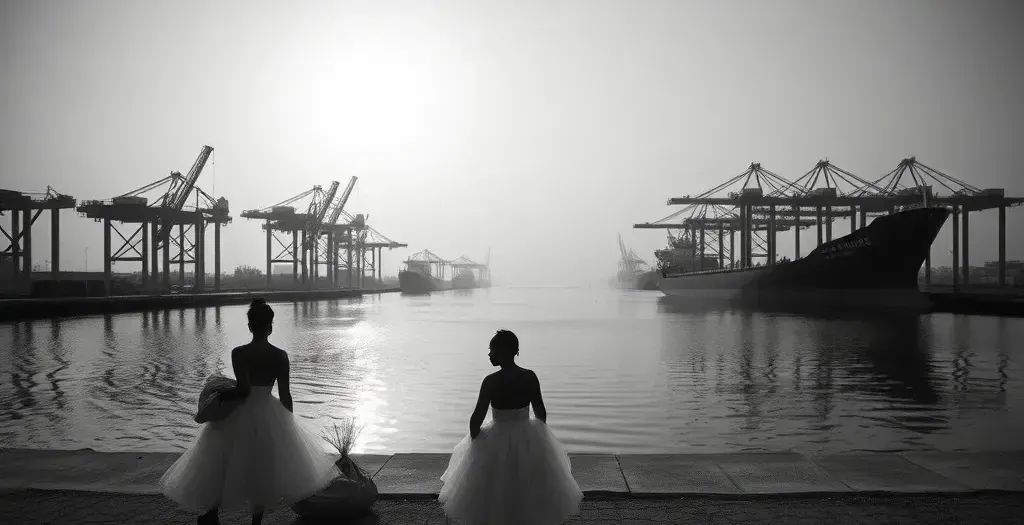
The school is about to be demolished. A $1.2 billion deep-water port, built by DP World (a Dubai-based operator) is expanding along the Atlantic coastline. The École des Sables sits in its path. The threat is real, the loss would be genuine, and the school's own website names what is happening with precision: "this former land of the tragedy of slavery, outraged by colonial rule, is now facing a new threat, this time called emergence, the catchword of triumphant Afro-capitalism."
Notice what this does to the narrative. The villain is now Gulf capital. The endangered institution is Western-packaged African art. The witness is the liberal Western press. The moral architecture arranges itself with perfect ease. The NYT can play its role clean, sympathetic, unimplicated. When the threat comes from outside the Western moral universe the finger points easily, the story tells itself, and the savior narrative updates its wardrobe without changing its structure.
Gulf capital demolishing a contemporary dance school in a fishing village on the Senegalese coast is not a story institutionalized decolonization can indict. It is not there to confront neoliberal capitalism, after all. So it watches. Writes another grant application. Convenes another panel.
Meanwhile the port moves closer. It doesn't read opinion pieces.