She Ritual : The Female Body as Archive, Offering, and Choreographic Site
Ling Huang's solo turns fan, rice, and red thread into physical restriction the body has to work against. Rainy J. reviews the performance.
by Rainy J.
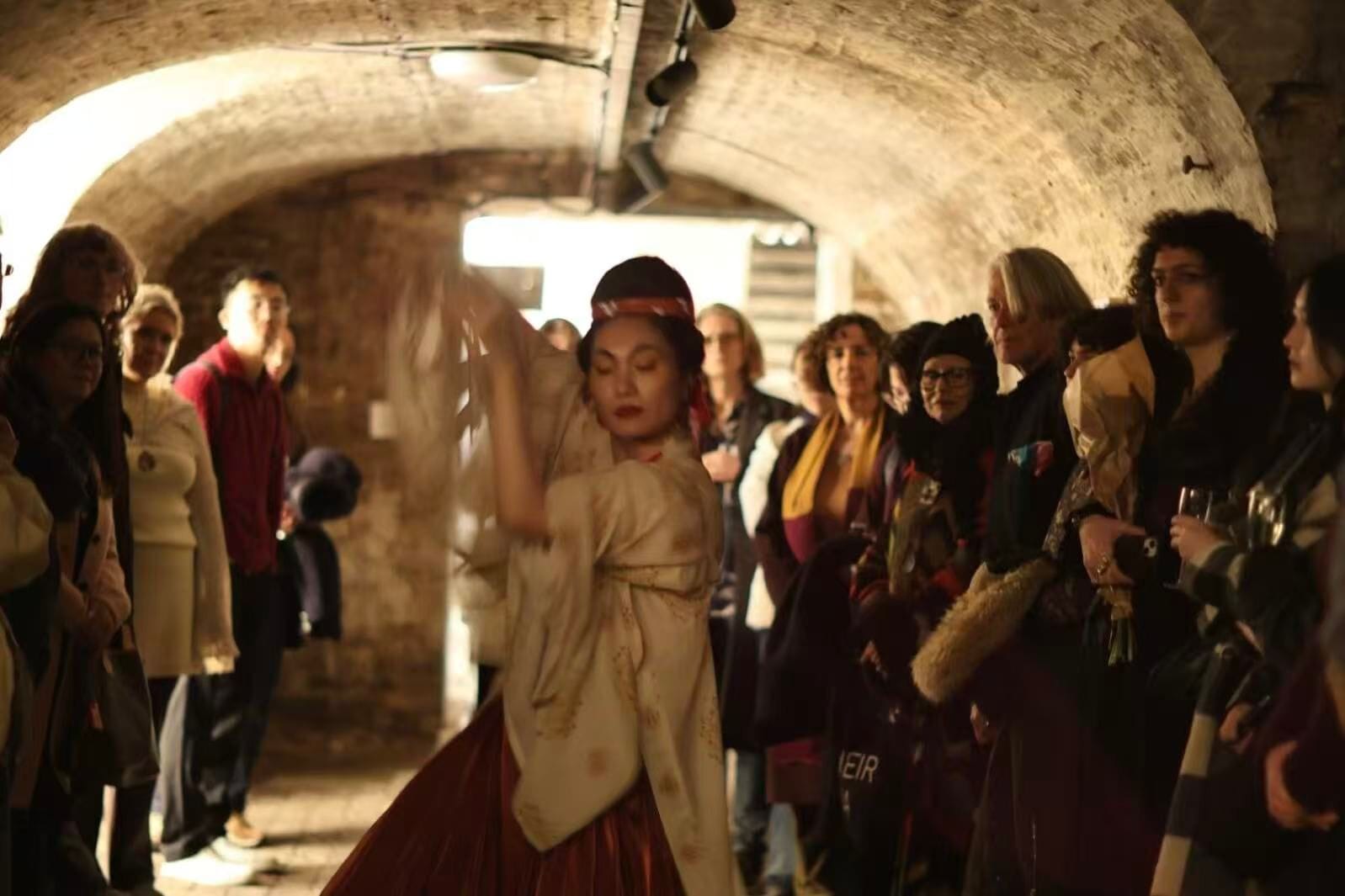
Under the low brick vaults of The Crypt Gallery, Ling Huang begins almost among the audience. There is no sudden entrance. She simply advances through small, measured steps, the arms circling slowly as the wrists unfold and the torso follows a soft, curved path.
At such close range, very little can be hidden: a finger lengthens, a shoulder settles, the weight arrives quietly through the feet. Huang’s control is immediately apparent, as is her grounding in Chinese classical dance. The hands are finely shaped, the transitions unhurried, and the upper body seems to float above a lower body that remains carefully placed.
The opening is composed with assurance, perhaps too much so. Its ceremonial atmosphere is established almost before the movement has had time to become uncertain. A small disturbance, a missed balance, a broken breath, a gesture that did not quite complete, might have given the polished surface more tension. Even so, Huang’s stillness has presence, and the intimacy of the gallery makes the restraint feel deliberate rather than remote.
A red Nuo mask is positioned behind her head. As she turns, her own face and the painted face separate, overlap and disappear behind one another. In the confined architecture of the crypt, the image is striking. At times, it seems less as though Huang is wearing the mask than being followed by it.
The mask carries familiar associations of protection, exorcism and ritual authority. Visually, it works at once. Choreographically, however, it remains more symbol than obstacle. It does not significantly affect Huang’s balance, sightline or use of the neck. Allowing it to interfere more directly with the body might have made the relationship between performer and object less settled.
The atmosphere changes when Huang removes the outer layer of costume and reveals plain white beneath. A red fan replaces the mask as the central object. It travels around the body, passes between the teeth and finally covers the face. The head begins to turn rapidly.
After the measured pacing of the opening, the acceleration comes with force. The fan becomes a red blur in the dim light, while the hidden face draws attention towards the strain of the neck and the increasing amplitude of the torso. This is the first moment in which an object seems to push back against the performer. Held between the teeth, it changes Huang’s breathing, interrupts her gaze and gives the movement a sharper physical urgency.
The sequence continues a little beyond its strongest point. Once the face has disappeared and the fan has taken over the image, further repetitions add less than the first few. A tighter edit might leave the visual impression burning more intensely.
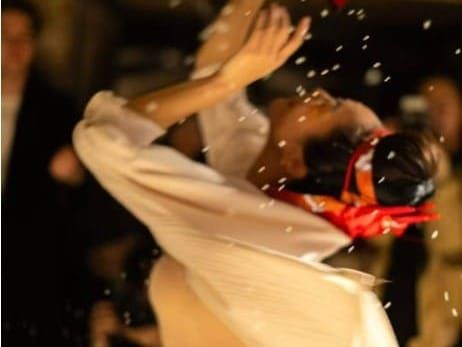
Rice changes the room more decisively. Audience members are invited to throw grains towards Huang, and the visual order of the opening begins to break apart. Rice strikes the floor, catches in the fabric and scatters beyond her immediate field of vision.
Huang responds through quick shifts of focus and weight. A hand rises towards a sound. The spine contracts after an impact. A planned pathway alters because the floor has changed beneath her. Her improvisation is alert and economical. She does not attempt to dramatize every grain; instead, she allows touch, sound, and peripheral vision to redirect the movement.
Rice naturally brings with it ideas of harvest, blessing, and communal offering, although the section is most convincing through its immediate physical effects. The grains make noise, touch the skin, accumulate underfoot and arrive from directions Huang cannot fully anticipate. The audience is no longer simply watching. It begins to affect the timing and conditions of the dance.
That openness introduces risk. The sequence depends on the confidence and rhythm of the spectators, and at quieter moments the pauses between each throw thin the tension. Huang has few means of intensifying the exchange when the audience hesitates. Yet the unevenness also belongs to the scene. She remains exposed to every gesture and must continue composing inside circumstances she cannot fully control.
The final section introduces red thread. Beginning at one ankle, it is wrapped gradually upwards, reducing Huang’s available movement with each turn. Her rotations shorten. The feet separate with difficulty. The centre of gravity shifts as she attempts to travel across the floor.
Here, the material is at its most effective. The thread drags against the costume, catches around the legs and redirects momentum. It does not simply represent restriction; it produces it.
The symbolism is clear. Bloodline, family obligation and inherited pressure are all present in the red thread, the white costume and the increasingly confined female body. At times, the image states its meaning more insistently than necessary. Once the body is visibly restricted, each additional loop confirms what has already been understood.
What keeps the section alive is Huang’s physical precision. She avoids broad displays of suffering. A knee fails to lift. A foot catches. The body rises halfway and drops again. Fatigue appears through repeated practical effort rather than theatrical emphasis. These small failures carry more emotional weight than the symbolism around them.
The final movement towards the corner completes the work’s gradual narrowing of space. It is an expected image of confinement, but Huang gives it weight through the effort required to reach it. By this point, even a short distance has become difficult.
Across eight concentrated minutes, She Ritual moves from composure to exposure, unpredictability and restraint. Huang performs that progression with exact timing and sustained physical focus. Her strongest choices allow the materials to alter what the body can do: the fan interrupts the breath, rice changes the floor, and thread shortens each step.
The work is less persuasive when its meanings are fully explained through color and recognizable symbols. It becomes more interesting when those symbols acquire physical consequence. A grain striking the skin, a fan cutting across a hidden face, a leg struggling against a tightening line—these are the images that remain.
In those moments, Huang makes ritual tangible. The body does not only present the ceremony, it carries its weight and shows its marks.
ABOUT THE PERFORMANCE
Watched at The Crypt Gallery, London on 13 November 2025
Running time: 8 minutes Approx.
Choreography and performance: Ling Huang
Original music: Guangrui Ju
ABOUT THE WRITER
Rainy J. is a London-based dance writer, choreographer and performer exploring choreography, screendance and contemporary performance.