Scorched Earth: Michael Keegan-Dolan’s Visceral Thriller Explores Land and Trauma
In a compelling fusion of psychological crime thriller and contemporary dance, Scorched Earth at Brisbane Powerhouse lays bare the tangled wounds of colonization, capital, and loss. Reviewed by Leila Lois.

by Leila Lois
Scorched Earth, which opened at the Brisbane Festival last week (17–20 September 2026) at Brisbane Powerhouse, is part contemporary dance, part psychological crime thriller, and dense enough with story and contradiction that the theatre's machinery falls away, drawing the audience into a compelling world.
Dramatist, writer, choreographer and performer, Murphy traces the work to "a fixation with ownership... which comes from relentless patterns of violence." The story is specifically Irish. His character, John McKay, is outbid by an outside investor for land he has tenanted for years, and his line, "having something that is yours taken from you", reaches past the auction to a wider wound, the alienation left by generations of oppression.
Its subject is dispossession: what it is to have something taken by colonisers, by capital, by forces that stay just outside the light, and what one might do in the aftermath.
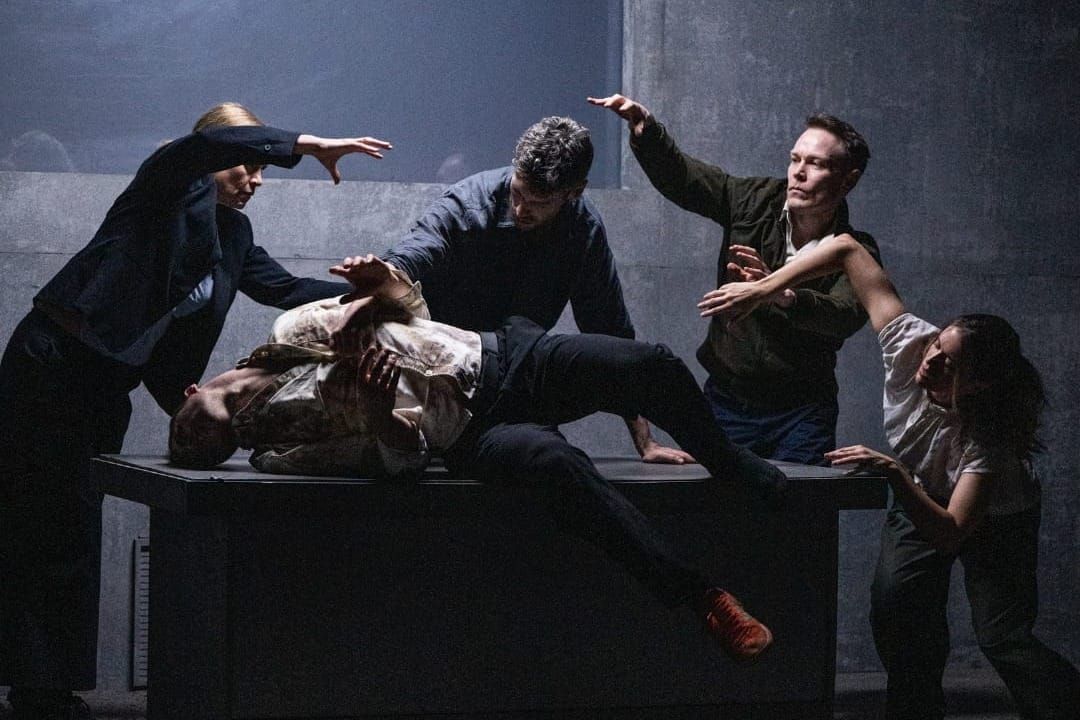
The hatch in the floor of Scorched Earth is a radio studio, then a bar, then an interrogation room, then a slab for the dead. Alyson Cummins's set tightens and opens, pinches and widens, and by the time it unfolds into a tussocked, sloped field, I had stopped seeing a stage at all.
Alienation runs through the structure. Detective Kerr (Sarah Dowling) interrogates McKay, and the narrative loops through the hours before and after the crime, each retelling shifting slightly. The murder itself, between McKay and the developer (Will Thompson), is danced low to the ground, all rolls and torsion, bodies wrung around each other. Around them, ensemble members draped in moss and grass move as the land itself, and their partnering with Murphy is close, entangled and interdependent, even at its most fraught. It resembles the way a traumatic memory works, returning unbidden and threading through everything else, as constant as daylight.
In the final sequence the dancers climb the slope and roll back down it, drawn by a gravity that reads as guilt. The physicality here is extraordinary as the dancers ascend and fall, embodying grit and exhaustion. After a long sequence, the other dancers fade to black as, at the top, Murphy stands in a hard spotlight, his face hollowed, and speaks the fateful line that closes the work: "look what you made me do." Then, black.
Scorched Earth had its Australian premiere at Brisbane Festival at a moment when the vocabulary of land is contested everywhere: custodianship against occupation, care against claim. Murphy, who choreographs, performs and holds the drama together, makes the argument in the body. The dancing is exact and tender at once, and what lingers is the ensemble's closeness, the way the mossed figures cling to the man who has lost them. It is a work that understands the wounding of land and the wounding of people as a single injury, each carrying the other's scars.
Leila Lois is a dance writer specialized in features, criticism and creative writing that captures feeling and place. Published internationally from Australia to Canada, she brings diverse media experience to every story, finding personality in culture worldwide.