What Chinese Dance Reveals About the Politics of Posture
From courtly sleeves to military uniforms, the body remembers what texts forget. An essay by Kari Fu.

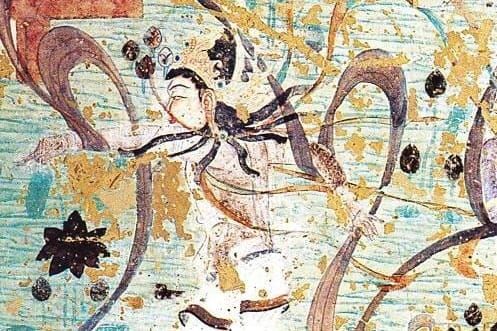
by Kari Fu
I stood in front of the studio mirror, trying to perfect my Mongolian Chopstick dance. This new style demanded a fiercer presence as I moved across the floor, contrary to the delicate movements I was used to with the Dunhuang style. I held my head high, lifted my chest, and grounded my feet to embody a confidence and commanding presence that felt entirely new to me.
Mongolian dance sits outside the dynastic lineage this essay traces, but the same logic: reading power onto one body, delicacy onto another, runs through other styles I have studied, long before I learned to name it.
History is often read through dynasties, wars, laws, and political leaders. Yet another archive exists: movement. Dance preserves cultural values in ways texts alone sometimes cannot. Whether it’s the posture of a body or the force of a gesture, even the social role assigned to a performer, these details may reveal assumptions about gender and power. Rather than proving historical realities directly, dance can be interpreted as a cultural record that reflects changing social ideals. Across Chinese history, evolving expectations surrounding womanhood and masculinity became embodied in dance characters, costumes, and movement styles. From the cosmopolitan confidence associated with the Tang court to the revolutionary heroines of the Cultural Revolution, performance became a lens through which changing gender roles can be studied.
As a classical Chinese dancer myself, it fascinates me how much one style of dance can differ from the other. The first time I switched from the Han dynasty’s elegant long-sleeve dance style to jian wu, a dance form often associated with the Tang dynasty which creates a more powerful and vigorous presence, it was difficult to rotate between two completely different body languages. It was this contrast, between the women portrayed, that made me wonder what had changed in the centuries between them. I noticed that these changes were not made on a whim, rather, each dynasty in Chinese history embodied many cultural and social shifts, in which their dances served as a reflection of that.
Tang Dynasty: Expansive Bodies and Visible Women
The Tang Dynasty is frequently described by historians as one of the most internationally connected periods in Chinese history. Through Silk Road exchange, court culture absorbed influences from Central Asia and beyond. Historian Bret Hinsch describes the Tang as an “open” era in which women enjoyed an unusually high level of freedom compared with many other dynasties. In his book, Women in Tang China, he notes that elite women participated in horseback riding, music, and other forms of court life that would become less common in the later Neo-Confucian periods.
Tang-inspired dance aesthetics appear to reflect this atmosphere. Costumes are often reconstructed with broad sleeves and layered garments creating wide, flowing movement. Female performers swung broadswords, slicing through the air, while heavy drums echoed beneath each leap. Here, a grand scene that matches the peak of imperial court choreography comes to life. Instead of emphasizing concealment or restraint, the movement in this era can appear outward and socially visible. One swift flip of the Tang-style sleeve becomes a symbol for power and authority.
Dance cannot be treated as a direct mirror of everyday life; however, these bodily aesthetics suggest a society that could imagine femininity as expressive and publicly present.
Song and Later Imperial Periods: Refinement and Restraint
During the Song Dynasty, Neo-Confucian philosophy had a growing influence on ideas about moral behavior as well as family roles and expectations for women. People placed more importance on modest behavior while encouraging self-control and a restrained image of femininity.
Performance aesthetics then gradually shifted as well. Dance and theatrical forms increasingly valued precision and control. Costumes included high collars, long skirts, and tightly wrapped sleeves narrowed the body’s outline, while restrained footwork helped keep dancers close to the ground rather than soaring through space like the dancers of the Tang Dynasty.
The idealized female body presented in artistic culture increasingly reflected social expectations surrounding restraint. On stage, the body became a reflection of culture, not just merely existing for decoration.
Rather than claiming that dance caused social norms, it may be more accurate to view performance as participating in broader conversations about acceptable femininity.
Cultural Revolution: Revolutionary Bodies and New Heroines
While the Chinese Cultural Revolution transformed politics, it more importantly constructed cultural production itself. Existing traditions were criticized and remade through revolutionary ideology. Scholar Emily Wilcox’s work on Chinese dance argues that movement traditions cannot be separated from larger political and social transformations. Her research demonstrates how dance bodies became sites where new social ideals were created and performed.
During the Cultural Revolution, traditional court heroines and literary women increasingly gave way to revolutionary protagonists: workers, soldiers, and political activists. As a result, costumes began to shift dramatically. Silk robes and flowing sleeves frequently yielded to military uniforms and practical clothing, while soft visual lines became sharper and more angular.
In terms of movement, dancers planted their feet into a powerful stance, driving each arm outward with sharp, angular force.
Perhaps most strikingly, the female movement increasingly adopted physical vocabularies traditionally coded as masculine. For instance, revolutionary heroines marched, leapt, and wielded weapons. They occupied stage space with authority, much of a change from the previous dynasties.
Yet this shift presents a complicated historical question: As revolutionary dance expanded representations of women by granting political and heroic visibility, some scholars, at the same time, argue that revolutionary aesthetics replaced older expectations with new collective ideals rather than fully liberating individual identity.
Bodies as Historical Archives
Across Chinese history, changing gender expectations altered many ideals surrounding movement itself. Whether it’s flying with grand jumps and turns in the expansive sleeves of Tang dance, or playfully hiding behind a fan for the refined bodily discipline of later imperial periods, each reflected different visions of womanhood.
Even today, dancers inherit these beautiful histories, sometimes without realizing. Oftentimes, we will be asked to move “more feminine” or “more powerful”, without questioning where these ideas originated.
As I learned and studied the many different Chinese dance styles, it became clear that changing posture and movement meant stepping into a different historical expectation of gender and culture. Those instructions are never purely technical; instead they carry centuries of these cultural expectations surrounding gender, whether we recognize them or not.
When I rehearse today, I am not just memorizing the choreography. My body shifts from the expansive sleeves of Tang court dancers to the disciplined restraint of later dynasties, then into the grounded strength of revolutionary heroines. Long after those worlds disappeared, traces of each still live in my spine, shoulders, and hands—and in every dancer who learns them.
Selected Academic References
Hinsch, Bret. Women in Tang China. Lanham, MD: Rowman & Littlefield, 2018.
Wilcox, Emily. Revolutionary Bodies: Chinese Dance and the Socialist Legacy. Oakland: University of California Press, 2019.
Kari Fu is a student, dancer, and writer with a passion for Chinese history and culture. She enjoys exploring how dance reflects social change and hopes to inspire greater appreciation for history through movement and storytelling.