The Spectre and the Shih Tzu: Conversation with Gabriel Semerene
On dance floors lost and found, queer Palestine, languages that carry whole worlds, the slow burn of academia, and Mei, a blind Shih Tzu who knows more about love than most of us ever will.

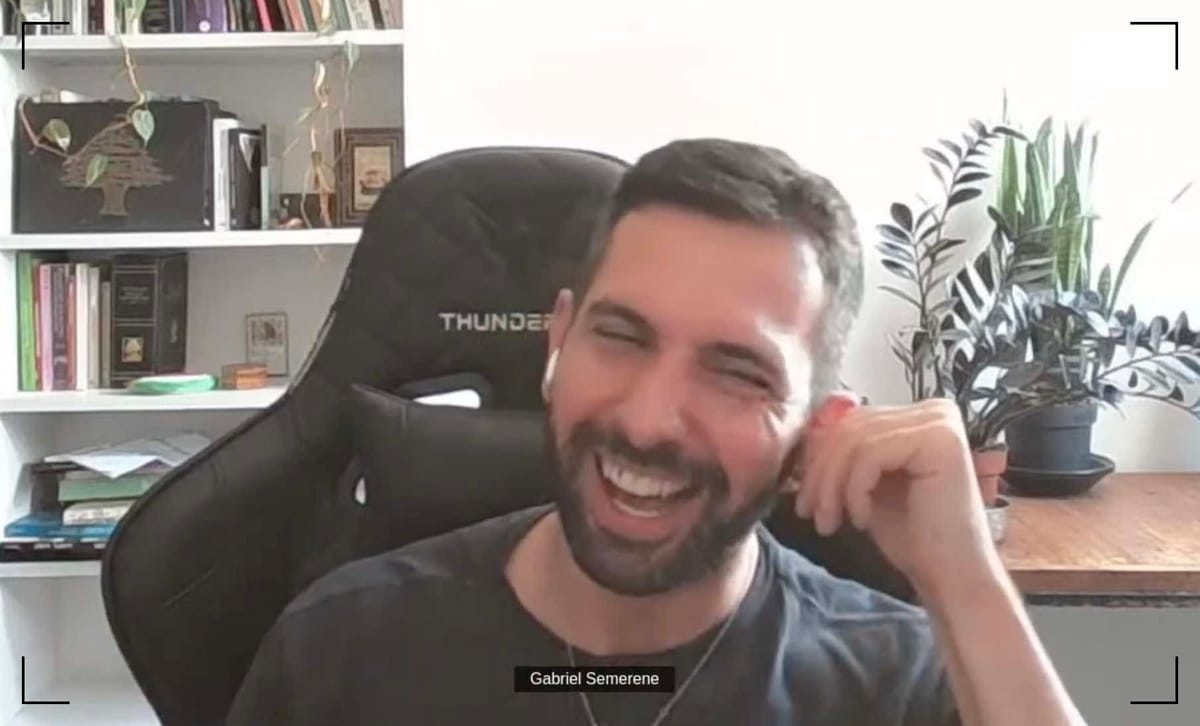
Gabriel Semerene first appeared in A Dance Mag's world the way the best writers do: unexpectedly, and with a compelling experience to share. His 2018 piece, "How Ketamine and Techno Helped Me Finally Understand Derrida," remains one of the texts that readers remember vividly, and revisit often. So, when we were building the editorial board for issues 4 & 5, bringing Gabriel back felt like a homecoming.
For the better part of a year, the editorial board spread across Brasília, Beirut, Istanbul, Berlin, and sometimes Delhi, met in the intimacy that video calls create when everyone involved actually cares about what they're making. You learn a lot about others that way. You learn how they think out loud, what makes them laugh, what they won't let slide. Gabriel, I learned, is someone who takes ideas seriously without taking himself too seriously, which, in the world of critical theory, is rarer than it should be.
This conversation covers a lot of ground: language and translation, Palestine and queer activism, the slow exhaustion of academia, and a blind elderly Shih Tzu named Mei who might be the most quietly philosophical figure in this entire interview.
1. Your first article for A Dance Mag, "How Ketamine and Techno Helped Me Finally Understand Derrida," resonated with many readers who find that clarity comes to them while on the dance floor. What's your current relationship with "dance" and "the dance floor"?
I was reading that piece again the other day, and I was surprised by how optimistic and hopeful that experience – and writing about it – made me. My relationship with the dance floor changed dramatically shortly after that, perhaps because I kept trying to recreate that experience or access a certain “dimension” that can only be accessed unintentionally. It wasn't easy dealing with the aftermath; how does one reintegrate language after having been outside it? It's something I'm still trying to figure out, eight years later.
So the dance floor became a site of anguish, and unfortunately it still is. For a while, I couldn't dance at all. I'd put some music on and wouldn't be able to feel anything. I even thought about writing another text, something about not being able to dance. I ended that text with a reference to something Derrida wrote about the “spectres that haunt us” and how we need to overcome them. Ironically, that epiphany became one of the major spectres haunting me.
"That's a translator's work: creating spaces in the target language where worlds from the original language can exist."
2. Besides Portuguese, you speak five languages fluently. I grew up reading Gabriel García Márquez in Arabic. The first time I read his work in French, I was shocked, “this isn't his world!” I thought. I assumed that South American literature is better read in Arabic, but I don't speak or read Spanish. Since you're familiar with all three languages and worldviews, would you agree or disagree with my assumption?
I can see that! I don't know if it's something about the languages themselves or if it's just hard to read something in a different language than the one you first read it in. It's like when I was a kid and my older sister was studying in Italy, she would bring me books in Italian, including novels by Japanese author Banana Yoshimoto, which I became addicted to. So I ended up associating Japanese literature with Italian, and it feels weird to read it in another language.
That happens quite often, we associate a language to a certain world. But I guess that's a translator's work: creating spaces in the target language where worlds from the original language can exist.
"Seeing that spark of radical transformation in the eyes of your students is priceless."
3. You have two master's degrees (Middle Eastern Studies, Comparative Politics, Languages & Civilizations) before your first PhD, and now you're working on your second. What makes academia so charming to you?
It's not that academia is charming to me; I'm just really bad at it, ahah. I have two master’s degrees (M2 in France). My first MA in Comparative Politics was quite frustrating, so I decided to switch to Arabic literature. Then I got a PhD scholarship in the same programme, but I didn't finish it. So now I'm working on my second PhD, but it's also my first.
I think academia as a principle is extremely important and has an unbounded potential for positive societal change. I think that's what attracts me. I've been deeply transformed by the works of so many scholars. However, even though the principle (an institution dedicated to the free pursuit of knowledge and thought) must be defended, the current reality is very distant from this principle.
I taught my first undergrad class last semester and it reminded me of why I wanted to become a researcher and a professor in the first place; seeing that spark of radical transformation in the eyes of your students is priceless. But the whole thing is just too exhausting. I'm deeply exhausted from academia and I keep being told, one way or another, that the only way to make it is to treat it as a bureaucratic job and to abandon hope and ideals.
So I've decided I'll finish this PhD and end my academic career there. I plan to apply for a civil servant position and focus on my literary translations and writing.
4. Your research documents Palestinian queer activist groups like alQaws and Aswat. How has their work evolved during the ongoing genocide in Gaza?
My current research is focused more on the transnational queer movement for Palestinian liberation, so I'll answer from that perspective. I also try to follow the Palestinian queer movement’s internal dynamics, but I don't have the means or the need to do it at the moment.
Sa’ed Atshan argues in his 2020 book Queer Palestine and the Empire of Critique that the Palestinian queer movement and its transnational solidarity movement were in a plateau, a sort of stalemate that was the product of paralysing critique. To make it short, the anticolonial/anti-imperial aspects of the movement were allegedly clashing with the advancement of sexual and gender diversity part. It's a lot more complex than that, but let's just say that this discursive field was saturated.
Since the beginning of the genocide in Gaza, this plateau phase has definitely ended. Not only did the transnational solidarity movement take an unprecedented magnitude, but I think the Palestinian queer movement reached a new level of maturity. It seems to understand its importance and role a lot more, both epistemically and pragmatically. AlQaws and Aswat successfully requested the suspension of Israeli LGBT organisation Aguda from ILGA (International Lesbian, Gay, Bisexual, Trans, and Intersex Association, basically the UN of sexual and gender minorities’ social movements) back in 2024. alQaws recently launched the Palestinian queer movement archive, which is part of a long effort to make sure the movement is an autonomous epistemic actor.
5. You've been working as a freelance translator since 2006. Which of your translation projects has excited you the most, and why?
Translating was mostly a way to make some extra money until last year, when I had the opportunity to translate two exceptional books: Rifqa, a poetry book by Mohammed El-Kurd, and Le palais des deux collines, a novel by Karim Kattan. Rifqa's launch event was just the other day in São Paulo, it was great. “Excited” doesn't begin to describe how I feel about translating those books. They're both from incredible young Palestinian authors whose voices are essential, especially right now. I highly recommend both books, Rifqa is originally in English and Kattan's novel has been translated into English.
My next step will be translating from Arabic to Portuguese. I'm already in talks with a publishing house to translate a book by a young author from Tripoli, the Lebanese city my family is from. I'm also really excited about this project; I hope it will work out.
"Much is said about the transformative power of love and all that, but when you witness it in such a visible way, it's just uncanny."
6. Tell me about your newly adopted dog, how is your relationship going so far? Did you notice any shifts in you since she stepped into your life?
You can say I “adopted” Mei, an almost 15-year-old blind Shih-Tzu, but she had already been in my family since she was a little puppy. Long story short, Mei lost an eye to myiasis shortly after I moved back to Brasília after 15 years. Then she lost sight in her remaining eye the following year. My sister, who's her original tutor, had just had a baby and everyone in the family was too busy to take care of Mei. She was left at my mom's country house basically to die, she was being fed and bathed, but that was kinda of it. So I decided to adopt her.
Mei was very depressed and had lost a lot of weight when I first took her home. She could barely walk, and when she did, she mostly walked in circles. I took her to the vet and made sure she got all the required treatments. She got visibly better each week and started walking more confidently with my help. She managed to get pretty independent on her own, and every time I see her make her way from her bed to the water bowl, I get teary-eyed. She still bumps into stuff quite often, but carries on undeterred. Much is said about the transformative power of love and all that, but when you witness it in such a visible way, especially when it's your love and care that's transforming another living being, it's just uncanny.
We developed an almost symbiotic relationship. Taking care of her is now my number one priority, and, although it can be pretty demanding given her age and special needs, I feel like it's all worth it when the day ends and she's sleeping soundly in her Snoopy-themed bed. We both help each other navigating the world: I take care of her and she teaches me how to be present and less anxious. Her task is infinitely harder to be honest.
I came away from this conversation thinking mostly about spectres—the ones that haunt Gabriel on the dance floor, the ones that haunt Palestinian queer movements, the ones that haunt all of us trying to do work that matters while the world burns. But I also came away thinking about Mei, a blind 15-year-old Shih Tzu in a Snoopy-themed bed, bumping into things and carrying on regardless. She has Gabriel. And it turns out that makes all the difference.