From Minuets to Algorithms: A Conversation with Katja Vaghi
The Swiss-Italian dance scholar on Baroque notation, digital bodies, and finding wabi-sabi in a hectic life.

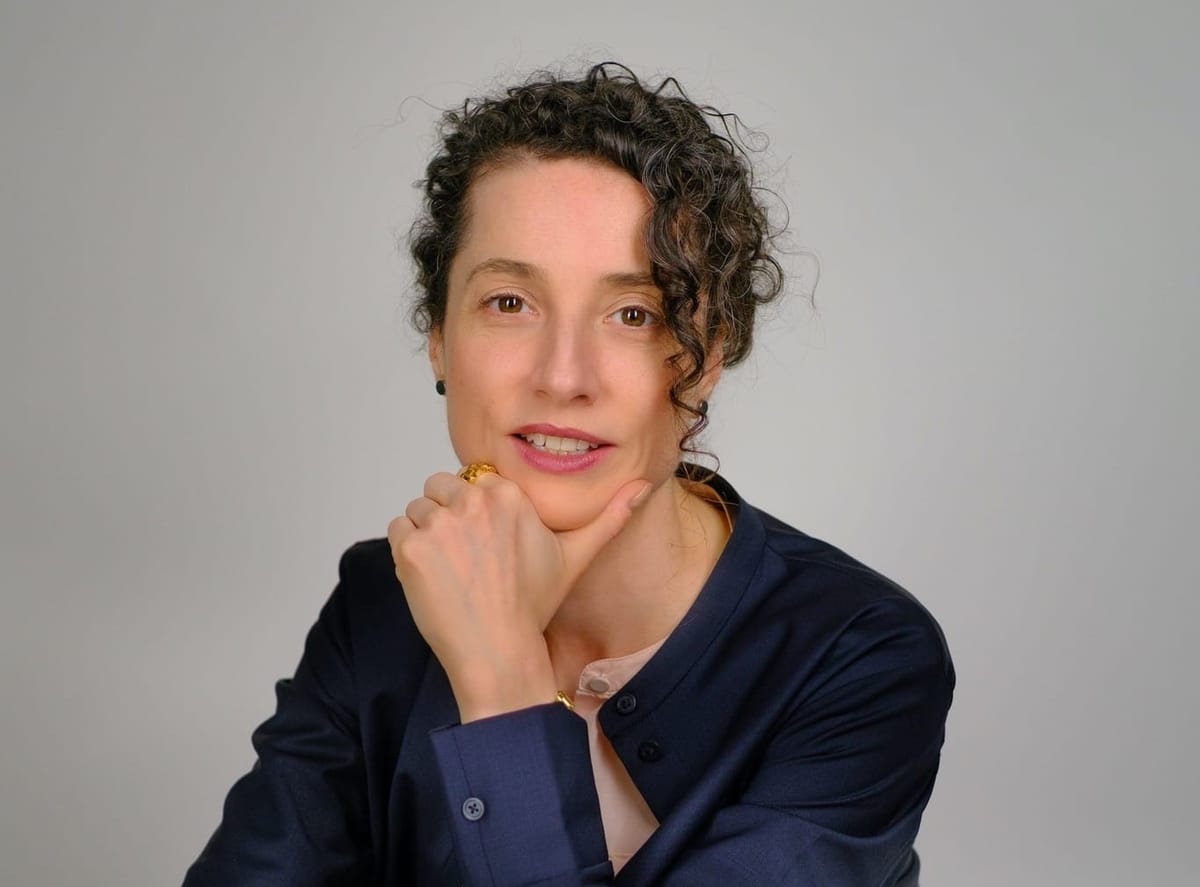


Katja Vaghi splits her time between Berlin, London, Prague, and Bern, researching everything from 17th-century Baroque notation to digital bodies and AI. A contributor to A Dance Mag's Structure (Issue 04) and Flow (Issue 05), she explores the tension between order and freedom that runs through dance history, from Louis XIV's court to today's algorithmic choreography. Over tea, we talked about mechanical ducks, wabi-sabi in hectic lives, and why she has no idea what she'd be doing if she weren't doing this.
You went from ballet classes in New York to studying Anglistik (English literature and linguistics), Italianistik (Italian literature and linguistics) and Norwegian Modern literature in Zurich to earning a PhD in dance philosophy in London. How did that journey happen?
I would say life happened. (Laughs)
You've lived in New York, Zurich, London, and now Berlin. Which city's coffee is best? And more seriously, do you feel at home anywhere?
I am more of a tea person (Laughs). Jokes apart, it is difficult to say. They were/are all central in my development. At home I am in all cities to some extent: in NYC I was at home in the modern dance and lyrical jazz classes, anything could happen in a day, like walking downstairs from ballet class and bumping into Baryshnikov or watching NYCB performing Balanchine. In Zürich, I remember the blue of the lake and sky, and the Rietberg Museum (displaying Asian, African and American and Oceanian art), seeing Kylián's Petite Mort at the Opera House and my first idea of combining what I was learning at university with the dance practice I had experienced. In London, I have found my dance research family, to which I am extremely in depth. I am now based in Berlin keeping ties with London and moving between Prague and Bern depending on the projects. In Berlin I delve into the experimental and edgy art scene.
Your essays reference everyone from Descartes to Zen Buddhism. Where do you find yourself on this spectrum?
I find myself trying to bring together different ideas of reality. Finally, they are all only finite reflections of a whole, like the pieces of mirror of a disco-ball, that can serve different purposes in understanding the reality around us.
In your essay, you write beautifully about embracing imperfection, about wabi-sabi and letting things be. But you also have a PhD and teach at multiple universities. How do you actually live that philosophy when you're rushing between classes? What does "simply being" look like on a Tuesday afternoon in Berlin?
(Laughs) This is a good question; I have always been an up-tempo person. I try to keep a beginner's mind and follow my interests. Currently, I am very touched by nature and could observe the transparency of veins in leaves against the sun or how the drops of rain rest on the flowers. We are all in a context that is very hectic, and letting things be is probably the best strategy. Maybe it is finding the wabi-sabi in a busy life. And taking breaks surely helps.
The pandemic forced everyone onto Zoom. You became a voice in screendance discussions, but you also warn that "the digital body is rendered perfect and eternal." What was your lowest moment during that time? Did the screen ever feel like a prison rather than a portal?
Funnily enough the pandemic and the movement to the screen only highlighted in my view the importance of the real body in everyday interaction and how this had gone unnoticed to the majority of the population. So, I cannot say I had a low time; the screen was a portal. At the same time, I was not teaching dance technique classes at that particular point in time. For the students starting then, we all can imagine, it has been very challenging. Kinesthetic intelligence works better when people are in the same room. There is a connection between bodies in the same space, something happening. You can literally ‘look’ with your back and know where other people are.
You're researching Claudio Schott and contemporary dance in 1980s Ticino. What did you find in the archives that made you gasp? Why is this particular moment in Swiss dance history relevant?
This is a particularly relevant moment in Swiss Italian dance history, as it is the first professional dance company. Ticino is well known because of the Monte Verità and the experimentation of Rudolf von Laban and Mary Wigman, who initiated the Ausdrucktanz. After they left at the end of World War I, only Charlotte Bara – dancer of the Weimar republic – was active on the territory. Claudio Schott united the dance professionals that were on the territory into a company in the Eighties and Nineties. It made me gasp that big artists of Videoart such as Nam Jun Paik (1989) have taken part in the VideoArt Festival in Locarno. The festival took place between 1980 and 2001.
Your work spans from 17th-century Baroque notation to AI and digital bodies. When you look at Louis XIV's dancers drilling their minuets versus today's dancers working with algorithms, what's the through-line? What hasn't changed about what it means to be a dancing body?
For the Baroque, I could mention the high interest in automata, the notion of the body as a machine and dance used as the symbol of the well-working state, as characteristic of the time. This can be very well compared to the contemporary glossy surface of the bodies created by the digital all surface and no depth. For me, the constant is still – we have yet to find a solution - the division between Körper (physical and anatomical body) and Leib (lived body), between what is presented to the audience and what is experienced by the dancer. Today, the experience of the dancer is coming more and more to the fore as training techniques such as gaga and other approaches to the body such as BMC (Body Mind Centering) focus on embodiment. Choreographers have also increasingly seen the audience as embodied viewers. Hopefully, this consciousness of our embodied being can transfer to other aspects of our everyday life and social being.
What movement always makes you feel like yourself?
Coming back to the body once the mind has been wandering in theoretical books or in the digital realm. A slow and conscious inhalation and exhalation, feeling lungs rest on the back of the ribcage and spine, and the ribcage embrace the lungs on top.
Favorite place to dance that isn't a studio?
Everywhere, it is always time for a tiny dance!
If you weren't doing this (the research, the teaching, the choreography) what would you be doing?
I don't know.
Katja's work invites us to sit with uncertainty, to embrace the flux, to find structure within flow and flow within structure. She's not offering solutions or step-by-step instructions. She's offering observations from someone who has spent years moving between theory and practice, past and present, the physical and the digital, and noticed something important about how bodies navigate constraint and freedom.
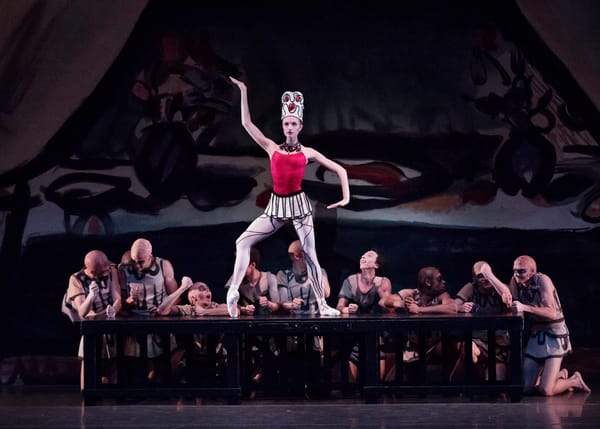
In her essays for A Dance Mag, she writes about Baroque dancers learning intricate notations, about Merce Cunningham throwing dice to generate choreography, about William Forsythe's shadow sculptures, about Anna Halprin's ritualized undressing. Each represents a different way of structuring flow, of imposing order on chaos or finding freedom within rules.
The question she keeps asking, across centuries, continents, and disciplines, is the one we're all living with: How do we move through a world that demands both structure and freedom, perfection and presence, optimization and being?
She doesn't claim to have figured it out. But she's found a way to keep dancing with the question. And honestly, watching her do it, with humor, with intellectual rigor, with genuine curiosity, with that beginner's mind she talks about, feels like enough.
Because maybe the point isn't to resolve the tension between structure and flow. Maybe the point is to notice it, to feel it in your body, and to keep moving anyway. To find the wabi-sabi in the busy life. To take the breaks. To notice the rain on the flowers.
To remember, always, that it's time for a tiny dance.
Katja Vaghi contributed "Fluctuating Structures" to A Dance Mag Issue 04 and "Structuring Flow" to Issue 05. She holds a PhD in Dance Philosophy from the University of Roehampton and teaches at institutions across Europe, including Danceworks Berlin, DansArt TANZNETWORKS Bielefeld and the Rambert School of Ballet and Contemporary, and the Coburg University of Applied Sciences. Her current research, supported by the Swiss Federal Office of Culture, examines the emergence of contemporary dance in Italian-speaking Switzerland.